
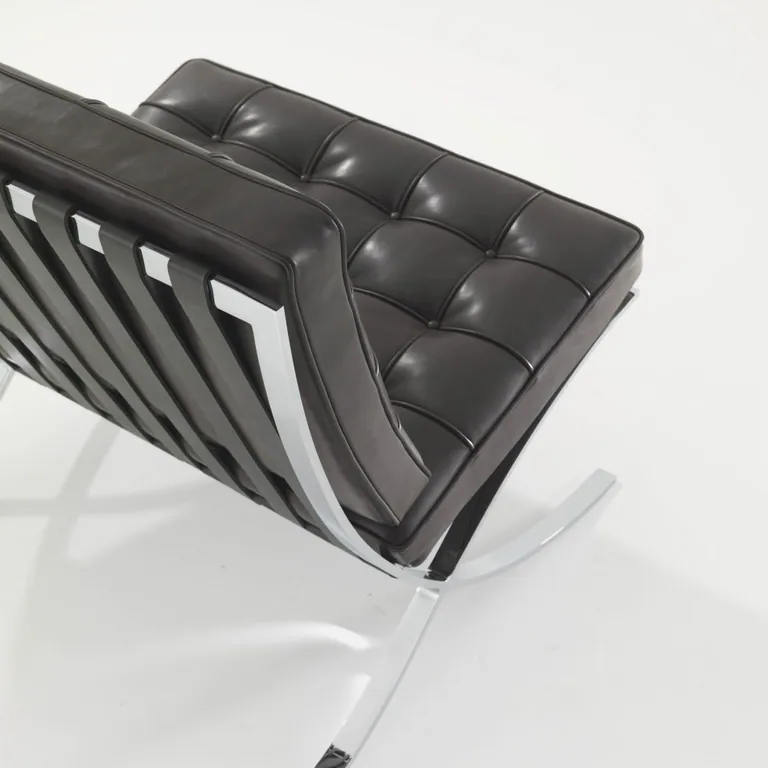

Knoll International Barcelona
International Barcelona. In his role as a rising figure of the modernist movement, Ludwig Mies van der Rohe was chosen to design the pavilion of the Weimar Republic for the 1929 Barcelona International Exposition. Through masterful proportioning and planning, Mies created a rhythmic and utterly unconventional space that elevated industrial materials to a level of elegance never before achieved. Inside, Mies incorporated chairs and stools intended as a resting place for the King and Queen of Spain. Determined to create a chair worthy of royalty, Mies is believed to have based the designs, with their characteristic crossed frames, on the folding stools of ancient Rome. As Mies put it: "I believe it must be possible to harmonise the old and the new in our civilisation." Although the Barcelona Pavilion stood for only seven months, it is regarded as a seminal achievement of modern architecture, as are the accompanying Barcelona Chairs (although the King and Queen reportedly never sat in them). Mies, a close friend and mentor of Florence Knoll during her time at the Illinois Institute of Technology, formally transferred the production rights for the Barcelona Chair and stool to Knoll in 1953. The designs immediately became a hallmark of the Knoll brand and have been manufactured to Mies van der Rohe's exacting standards ever since.


