

A throne the king never sat on
Mies van der Rohe built it in 1929 for a king who never took a seat in it. Today it is one of the best-known chairs in the world, and its story is almost as beautiful as the chair itself.
Berlin · 1929
A throne of spring steel
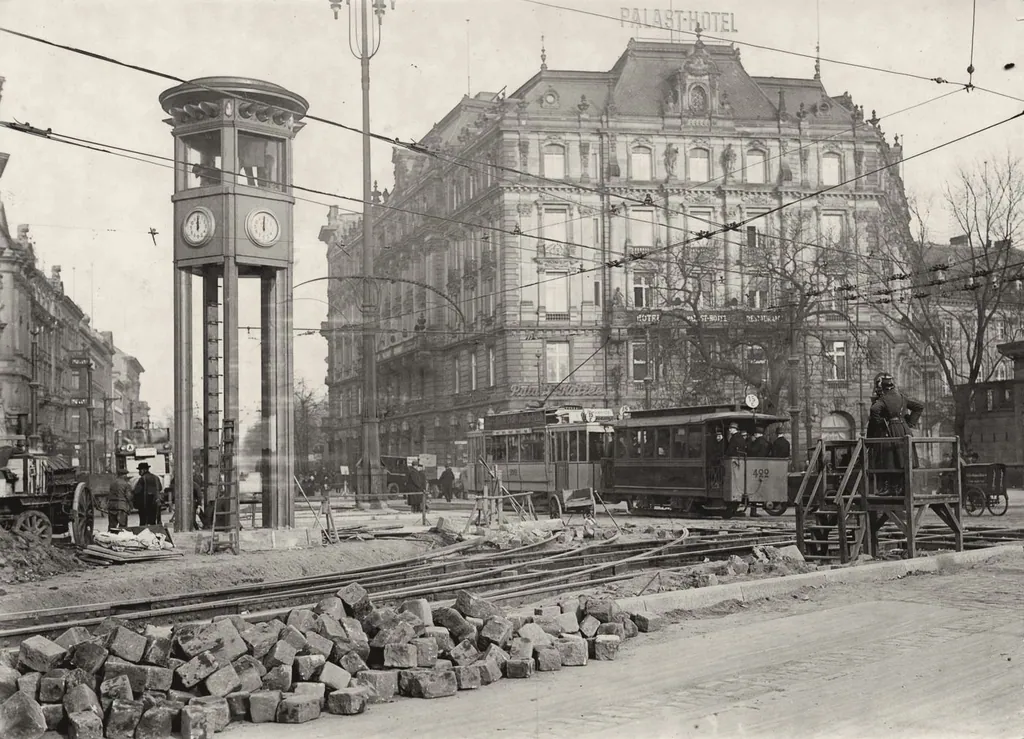
Stroll through the streets around Potsdamer Platz in the spring of 1929 and you might pass a large apartment in an old building on Am Karlsbad, where one of Berlin’s most headstrong architects lives and works. Ludwig Mies van der Rohe is in his early forties, a broad-shouldered man in a dark suit who puts on a bowler hat to go out and is hardly ever seen without a cigar. Models are set up and photographed on his balcony, and in the house next door a whole team is hard at work on the commission that will make him famous.

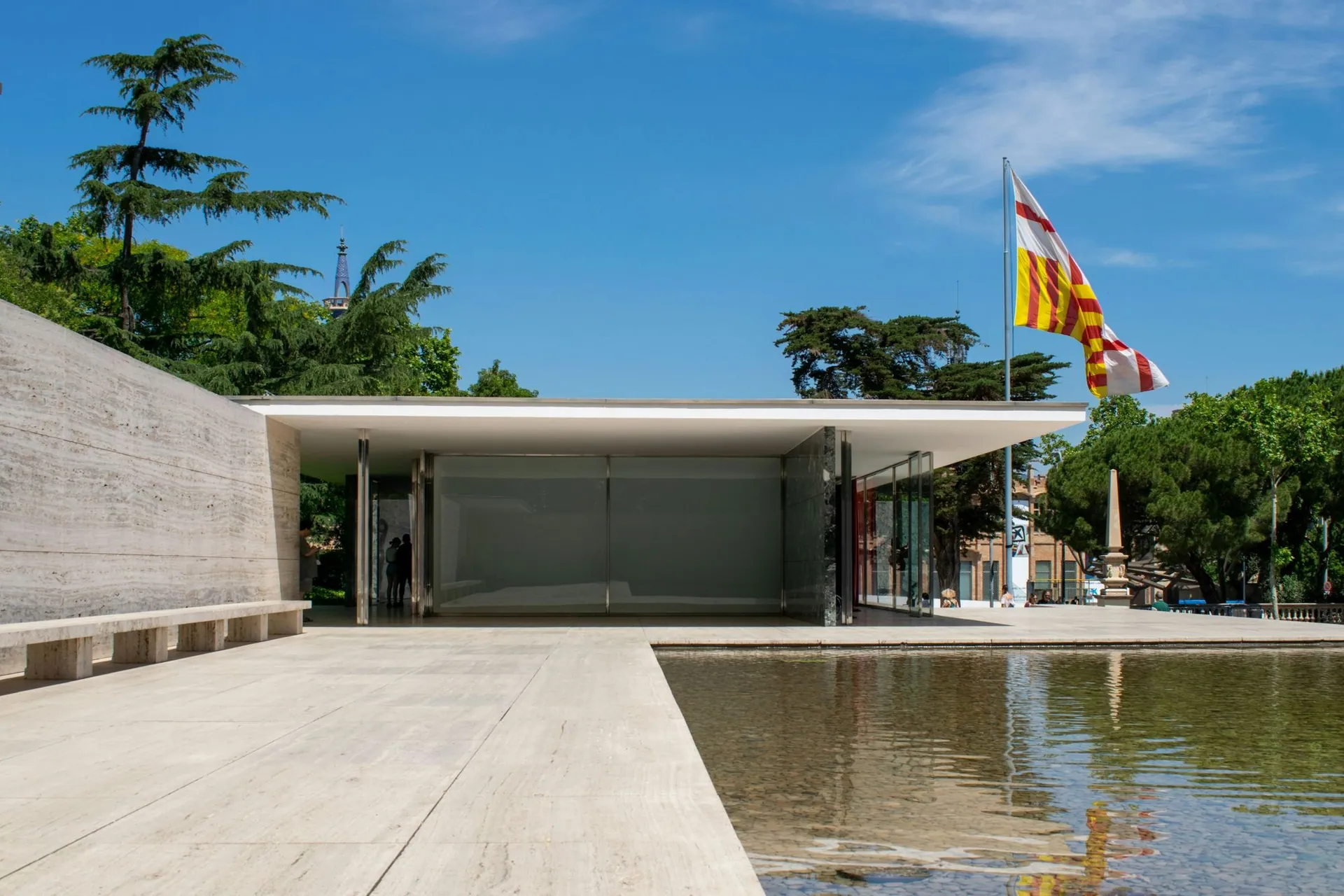
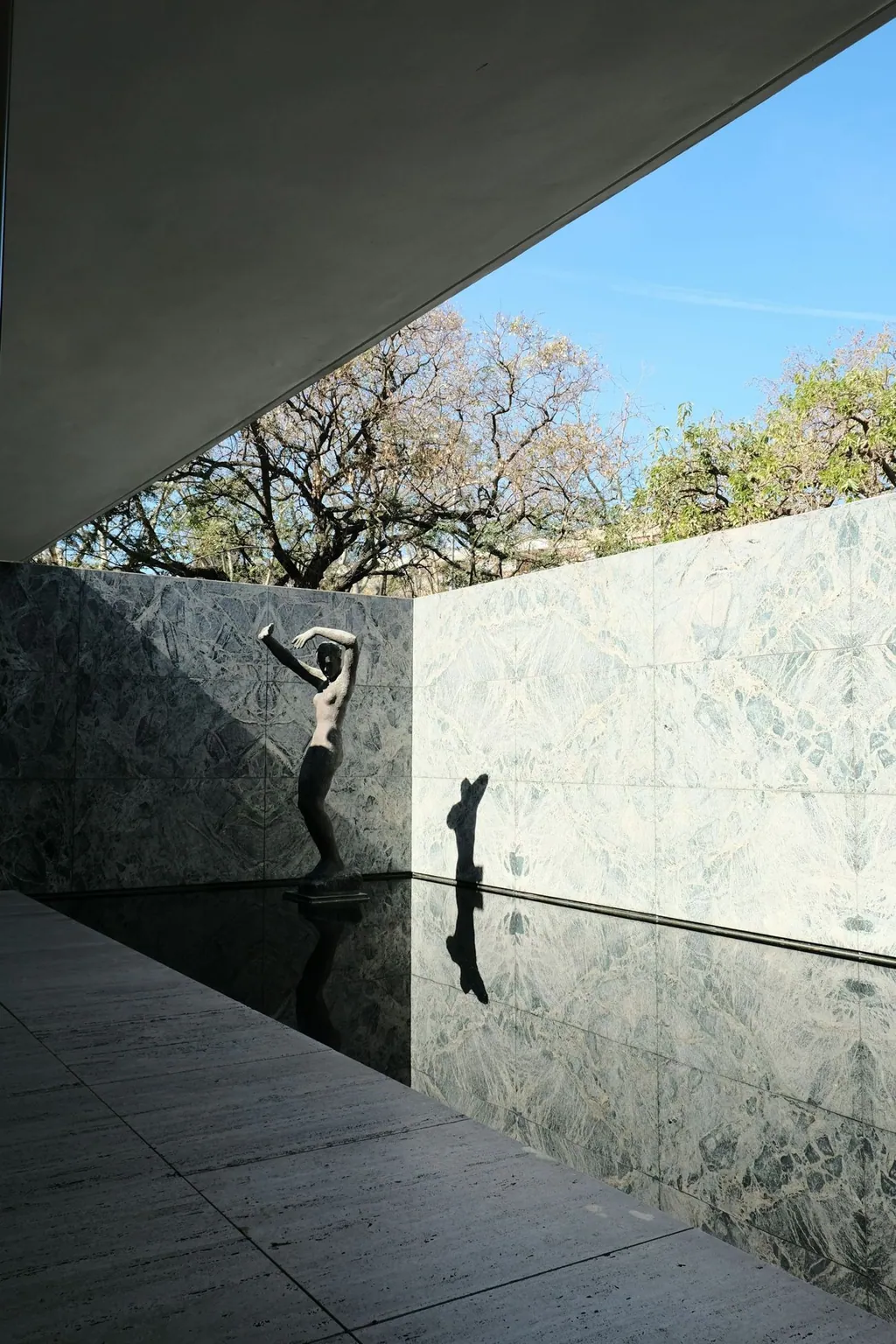
Right now, though, he is wrestling with a rather royal question. In Barcelona the German Pavilion for the World Exhibition is going up to his designs, and the King of Spain is due at the opening. The only problem: what do you seat a king on in a building of glass, steel and marble? An ordinary armchair will hardly do.
Mies is after something with all the dignity of a throne that still doesn’t clutter the space. He draws, discards and draws again, and so many prototypes pile up in his office that at some point he invites his staff simply to take the rejected ones home.
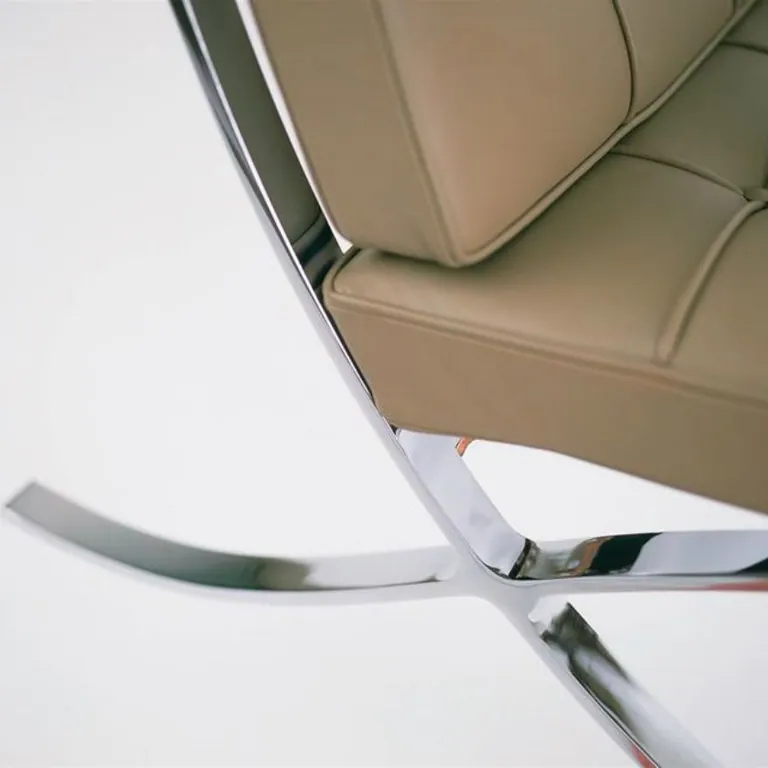
In the end he settles on two curved bands of flat spring steel that cross beneath the seat and are fixed together so firmly that the chair needs no joint, yet gives ever so slightly when you sit down in it. The first pieces are made by hand in a small Berlin metal workshop, and Mies makes a point of standing beside them and watching.
Barcelona · May 1929
The day the king walked past
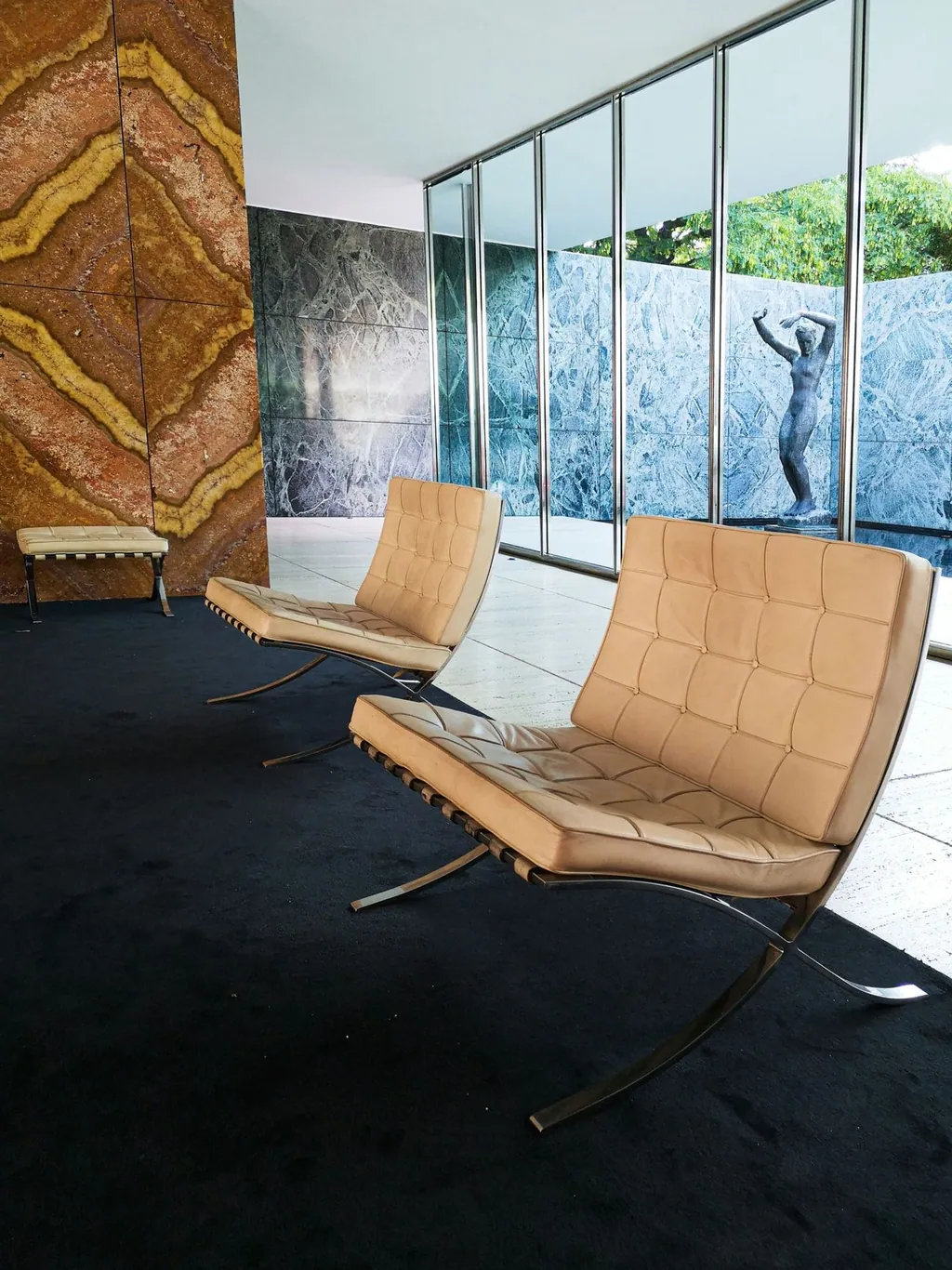
With time running short before the opening, Mies has the chairs flown in to Barcelona at the last minute. On the big day he stands among the guests in white tie, top hat and gloves held to his chest, while the royal couple listen to the speeches, drink a glass of champagne and sign the visitors’ book. The guests, meanwhile, sit on the plainest of tubular steel chairs. And the chairs built specially for the king? Alfonso XIII and Queen Victoria Eugenie simply walk past them.
Mies doesn’t seem too hurt by it. A few days later he tells a newspaper, quite contentedly, about his new piece of furniture.
Mies van der Rohe, a few days later, in a newspaper · translated from the Spanish by Dietrich Neumann‘I have designed a new type of furniture made from materials not previously used. The results are very comfortable …’
Berlin & Brno · 1930
A bachelor with a butler
Back in Berlin, Mies enjoys his new fame to the full. His assistant Sergius Ruegenberg is surprised to see his boss suddenly sporting a monocle and a gold watch on a long chain, and instead of a housekeeper there is now a butler to look after him. The flat has white linoleum floors, floor-length dark blue silk curtains hang at the windows as in a theatre, and in the middle of it all stands the furniture from Barcelona.
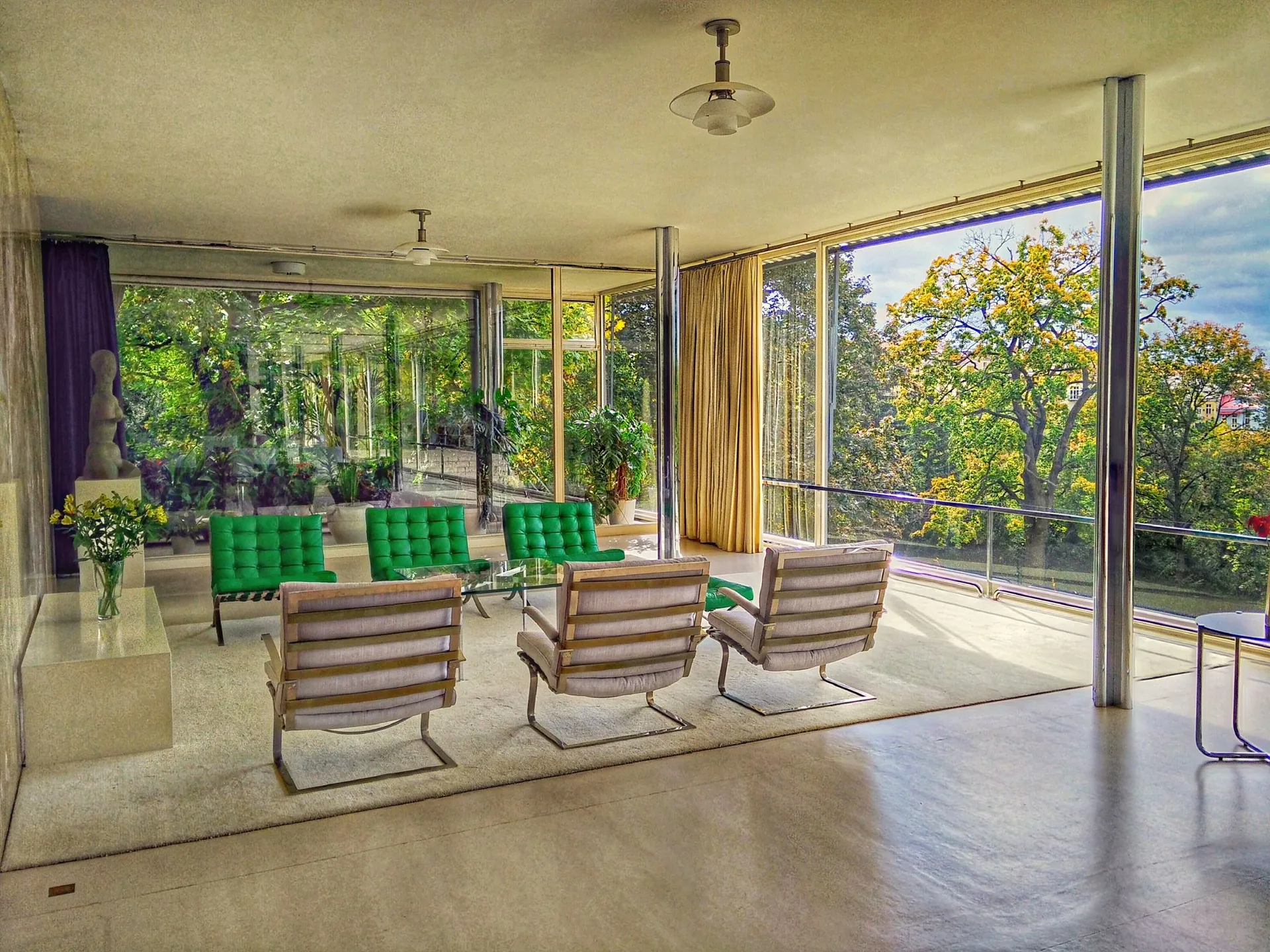
A year later the chairs find a home every bit as fine as the pavilion: the house Mies builds for Grete and Fritz Tugendhat in Brno. Grete’s family, wealthy Jewish industrialists, give it to the young couple as a wedding present, and today it is a UNESCO World Heritage Site.
Chicago & New York · 1938–1965
Friday mornings in New York
At this point, by the way, none of this has anything to do with Knoll. For almost twenty years the chair remains a piece for the very few, built by hand for individual houses and clients. The story only gets going when Mies moves to Chicago in 1938, because there, in his classes, sits a young architecture student who likes to drop in on him for a coffee on her way home: Florence Schust.

Florence later moves to New York, joins the small furniture company of Hans Knoll, an emigrant from Stuttgart, and marries him. Together the two of them turn Knoll into the company that brings modernism into America’s offices and living rooms, and after the war Florence adds her old teacher’s designs to the range. Knoll has made the Barcelona Chair since 1948, at first in a small New York workshop where a man from Knoll calls every Friday morning to collect five chairs, two stools and a table.
Not everything goes smoothly. When Mies’s office later re-engineers the chair for stainless steel, a prototype collapses under a colleague built roughly like Mies himself, and Mies finds it enormously funny. In 1965 he finally sells Knoll all the rights to his furniture for $150,000, spread over ten years.

Ever since, every original has come from Knoll, and the cushions are still sewn by hand today, square by square. Mies never gave it its name, incidentally: he simply called it the ‘pavilion chair’, and it only became the ‘Barcelona Chair’ in America after the war.

What you should know before you buy
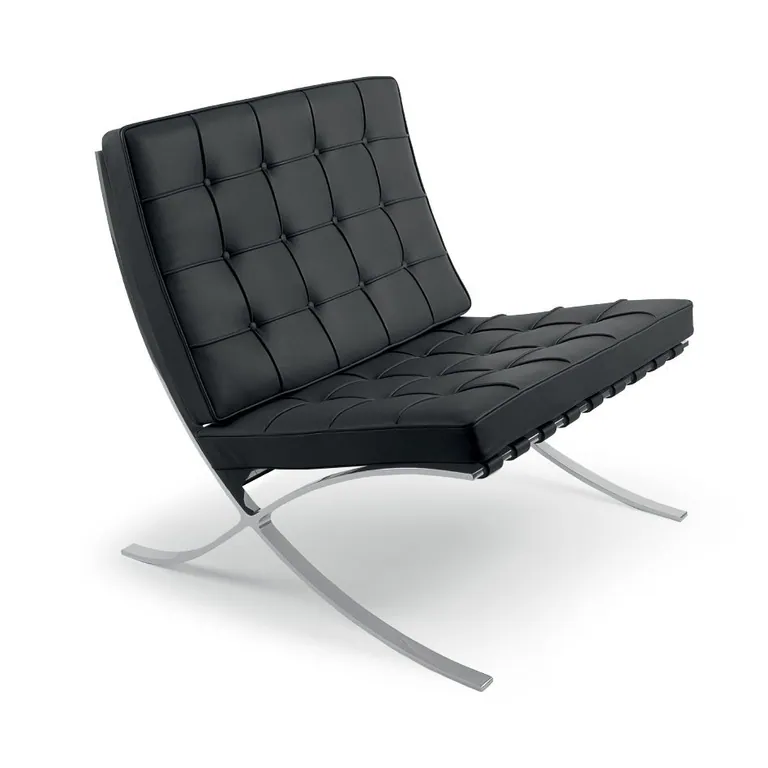
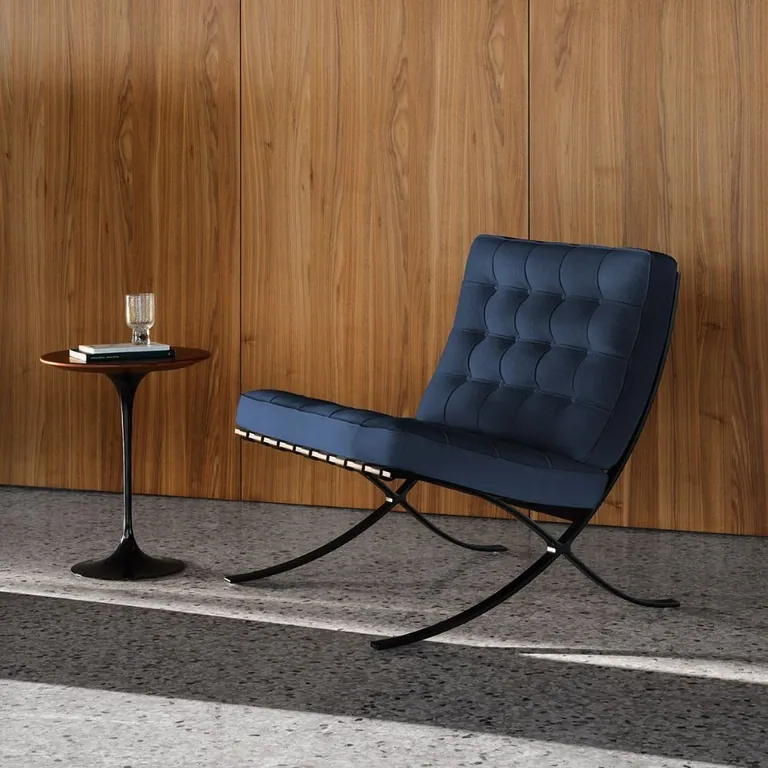
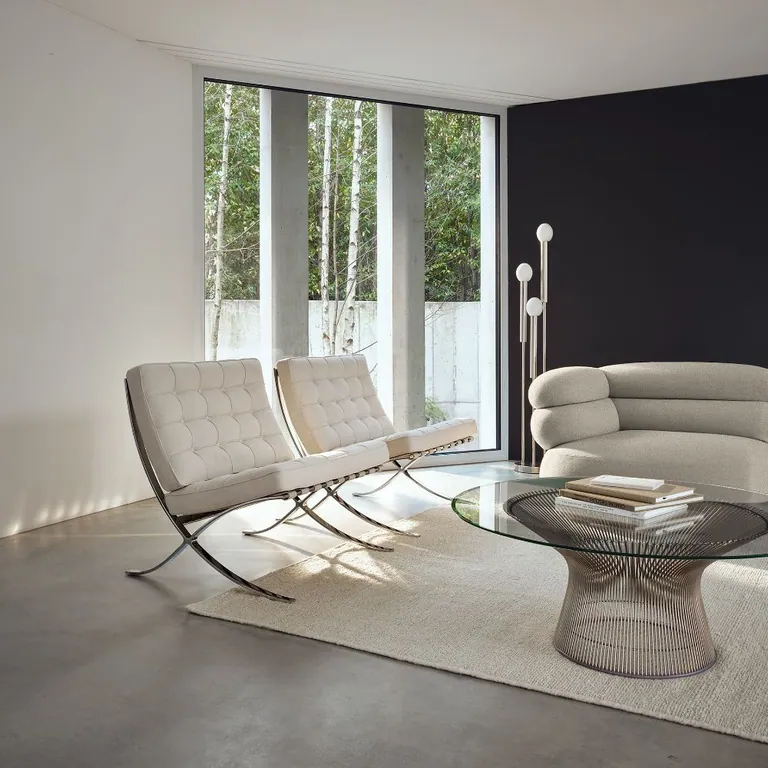
| Classic | Relax | |
|---|---|---|
| Upholstery | cushions on leather straps, just as Mies designed it | multi-layer upholstery, noticeably softer |
| Back | hangs from straps | fixed to the seat with a pin |
| Leather | Knoll’s leather collection | also in especially soft full-grain leathers |
| For whom | if you want the original, a little firmer | if you like to read in it for hours |
| Dimensions, frame | identical | |
BOTH CHAIRS FROM US


- 75 × 77 × 77 cm, the same for both
- 43 cm seat height
- approx. 21 kg set it down once and leave it there
Since the mid-1990s the Knoll logo and Mies’s signature have been stamped into the rear right leg. 40 leather panels from a single hide, 17 straps. Older chairs aren’t stamped yet, and that alone doesn’t mean they aren’t originals.
Not allowed in Germany: the courts, right up to the Federal Court of Justice, have classed the chair as a protected work of art.
Leather with a soft cloth and mild soapy water, chrome with glass cleaner. Knoll offers a five-year warranty.
We are an authorised Knoll dealer and are happy to help with leather, colour and the question of Classic or Relax. Browse the Knoll collection
The king walked right past it.
You’re welcome to take a seat.
Sources
Franz Schulze and Edward Windhorst, Mies van der Rohe. A Critical Biography (2012); Dietrich Neumann, An Accidental Masterpiece (2020); Daniela Hammer-Tugendhat, Ivo Hammer and Wolf Tegethoff, Haus Tugendhat (2020); Brian Lutz, Knoll: A Modernist Universe (2010); patent specification DE 486722; Knoll, product data sheets; BGH (German Federal Court of Justice), judgment of 5 November 2015, I ZR 91/11.
Pictures
Historical photos in the public domain: Josep Brangulí (1929), Hugo Erfurth (1934), Potsdamer Platz 1924 (unknown), John Vachon (1940, 1943), Lesser Ury (1925), Kurt Schwitters (1922). Product photos: Knoll. Pavilion today: Pia Fuhst, Vincenzo Biancamano, Johnny Ho (Unsplash). Villa Tugendhat: r chelseth (CC BY 2.0), Thomas Ledl (CC BY 4.0), both edited. Mood images: Pexels. Map: Natural Earth.