

A chair made of air and wire
Harry Bertoia never thought of himself as a furniture designer, and yet the Knolls gave him a workshop and asked only that he give furniture some thought. Two years later the Diamond armchair stood in their New York showroom, and its story runs from a village in Friuli to a barn that sings.
Friuli & Detroit · 1915–1937
White pebbles
San Lorenzo is a small village in Friuli, somewhere between the Alps and Venice, and this is where Arri Bertoia grows up – Arieto, little Arri, as the villagers call him. His world stretches exactly as far as he can ride his bicycle in a day.
What stays with him from those years he later describes in fine detail: a river of crystal-clear water running over pebbles that shone whiter in the sun than anything he would ever see again. And the rare evenings when his father’s brothers played chamber music together while the boy listened ‘almost enchanted’.
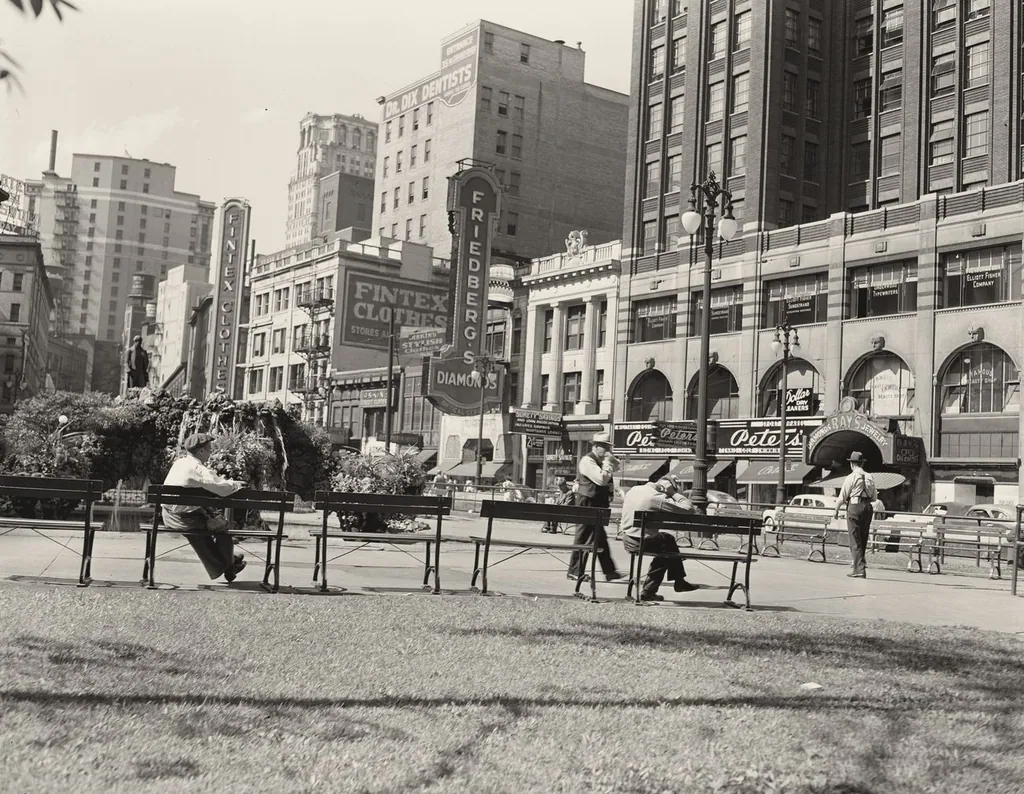
As a teenager he is already drawing embroidery patterns for the village brides’ trousseaux, and before long an art teacher from the next village tells his parents there is nothing more he can teach the boy. In 1930, at 15, Arri leaves for Detroit, where his older brother Oreste already lives. There Arri becomes Harry, and at Cass Technical High School he soon wins one art prize after another.

Cranbrook · 1937
Jewellery from almost nothing
In 1937 he wins a scholarship to the Cranbrook Academy of Art just outside Detroit, where the artists live on the grounds and the students learn from them and from one another. And what a crowd it is! Eero Saarinen, the director’s son, Charles Eames, Ray Kaiser, soon to be Ray Eames, and a young woman named Florence Schust, whom the world will later know as Florence Knoll.
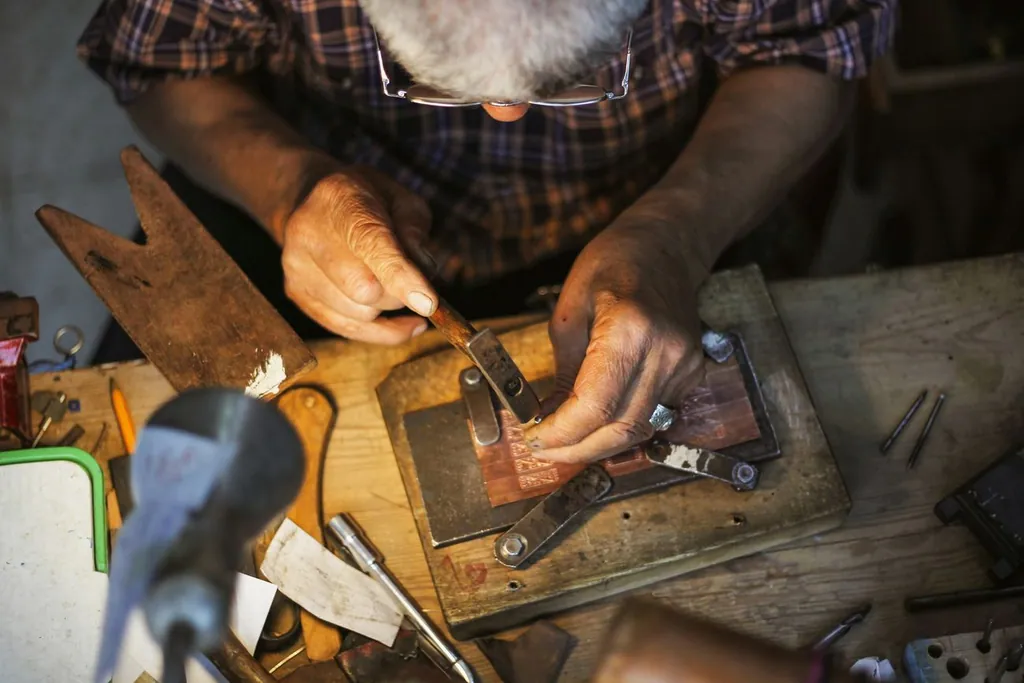
The director, the Finnish architect Eliel Saarinen, asks Bertoia to reopen the metal workshop, which has stood idle. Then the war comes, metal grows scarce, and Bertoia turns to the thing that needs the least of it: jewellery. Out of his hands come brooches and rings in soft, organic shapes, some even made of cotton thread, and for Ray Eames he makes her wedding ring.

In the evenings he makes prints in a way he has invented himself: he lays paper on a layer of printing ink and draws on the back with his thumb or the palm of his hand, without really seeing what is taking shape – which is exactly what he likes about it. He sends around a hundred of these sheets to the New York museum that would later become the Guggenheim, really just to hear what they think. Hilla Rebay, who is building its collection, buys all hundred.
In 1943 he marries Brigitta Valentiner, and the young couple move to California.
California & Pennsylvania · 1943–1952
Why not think about furniture?
In California Bertoia works for Charles and Ray Eames, who send him on a welding course, and what he learns there becomes his tool for life. His ideas, however, so his family tells it, find their way into the Eameses’ plywood chairs without his name appearing anywhere, and in 1946 he leaves, disappointed.
In 1950 Florence and Hans Knoll come to see him. The graphic designer Herbert Matter had pointed them his way, and they bring him to Pennsylvania, where Knoll has its factory. Their offer is generous and remarkably open: a workshop, time, and nothing more than the request that he might give furniture some thought.

‘There was not a single pair of pliers, a hammer, a grinding wheel … nothing!’ Bertoia later recalled of the small room in the factory that became his first workshop. When Hans Knoll suggests he visit hospitals and offices in case they spark ideas, Bertoia politely declines: his ideas, he says, come from ‘an inward direction’.
And so he starts not with the wire but with the body. On a plywood rig he works out how a person sits, and only then does he sketch in the air with wire the shape the grid might take. Dick Schultz, a young developer at Knoll, finds the first prototype as orderly as ‘something that grew out of nature’.
New York · December 1952
Right at the end: chairs
In December 1952, for the first time ever, Knoll gives a single artist an entire exhibition – the 37-year-old Harry Bertoia – and the showroom high above Midtown Manhattan is completely transformed for it. The headline of the press release lists paintings, drawings and metal sculpture. And right at the end: chairs.
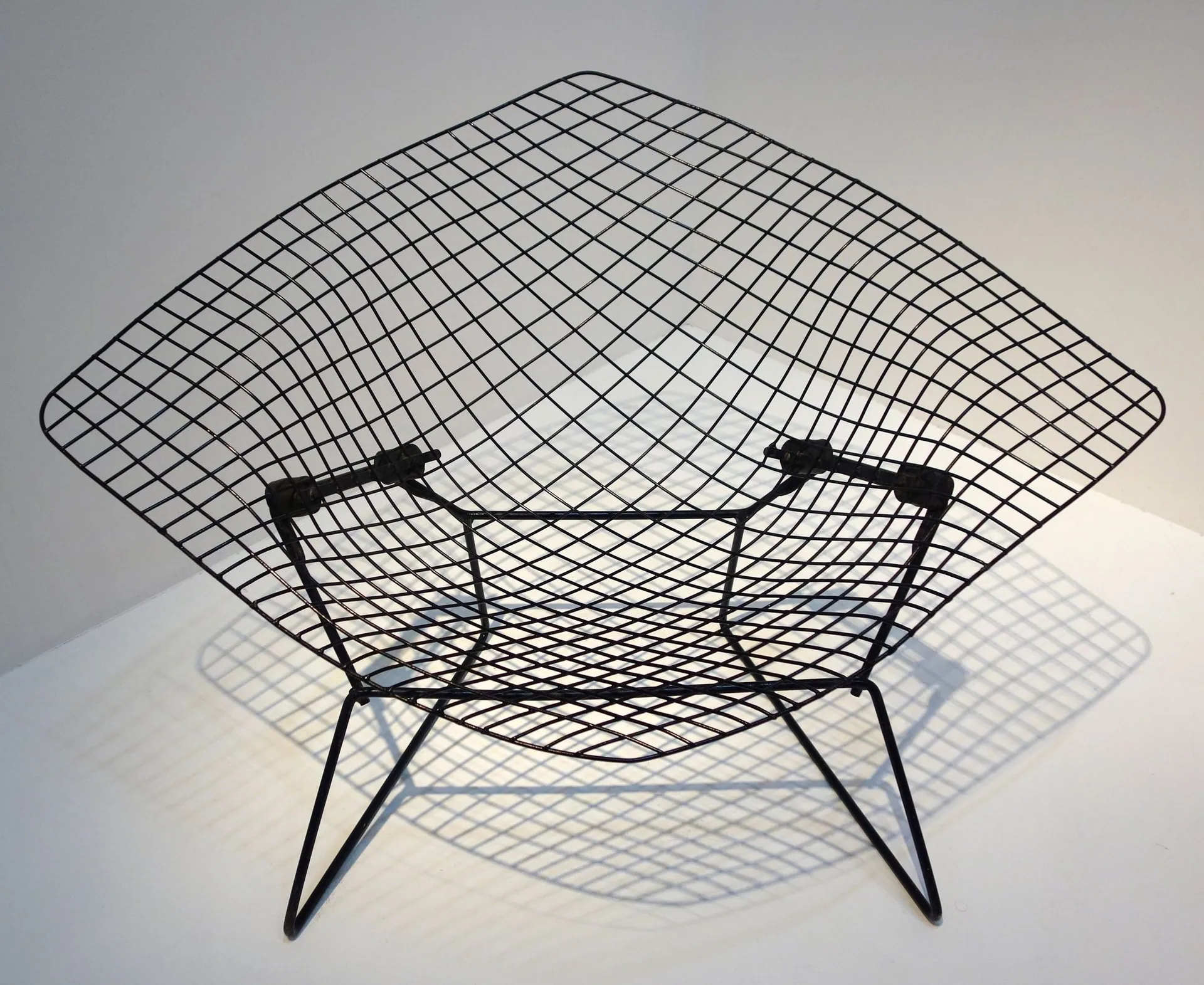
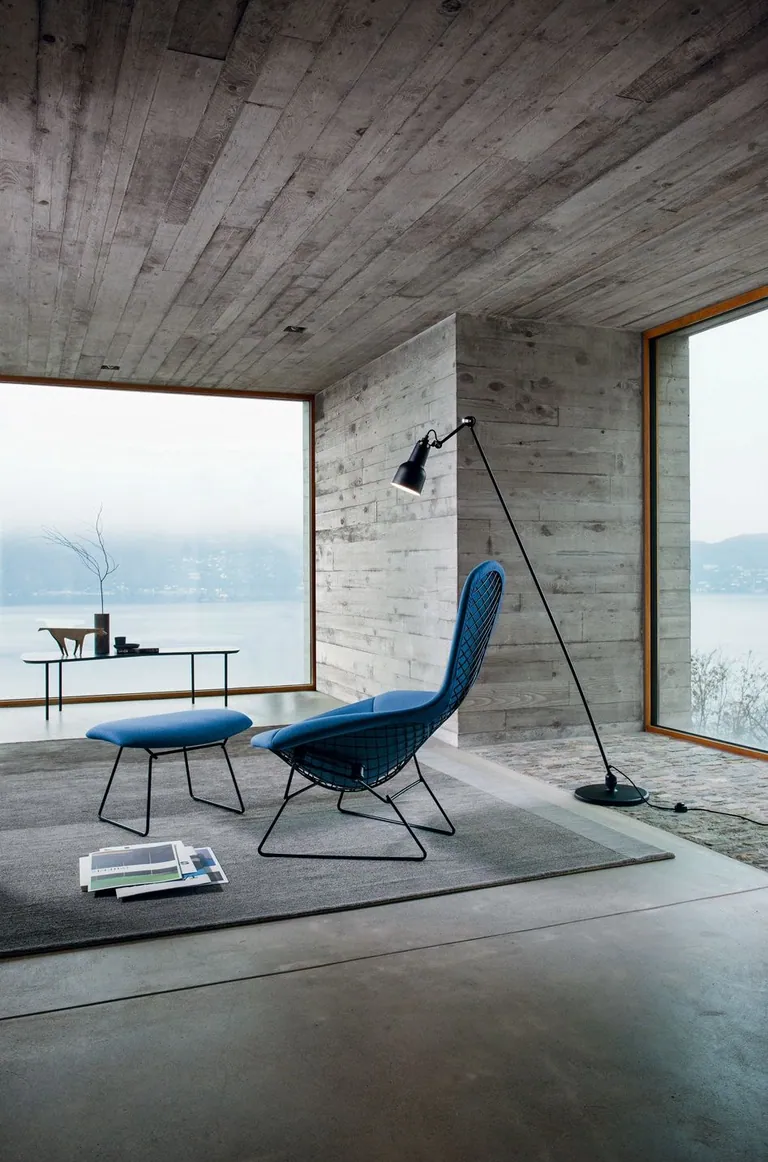
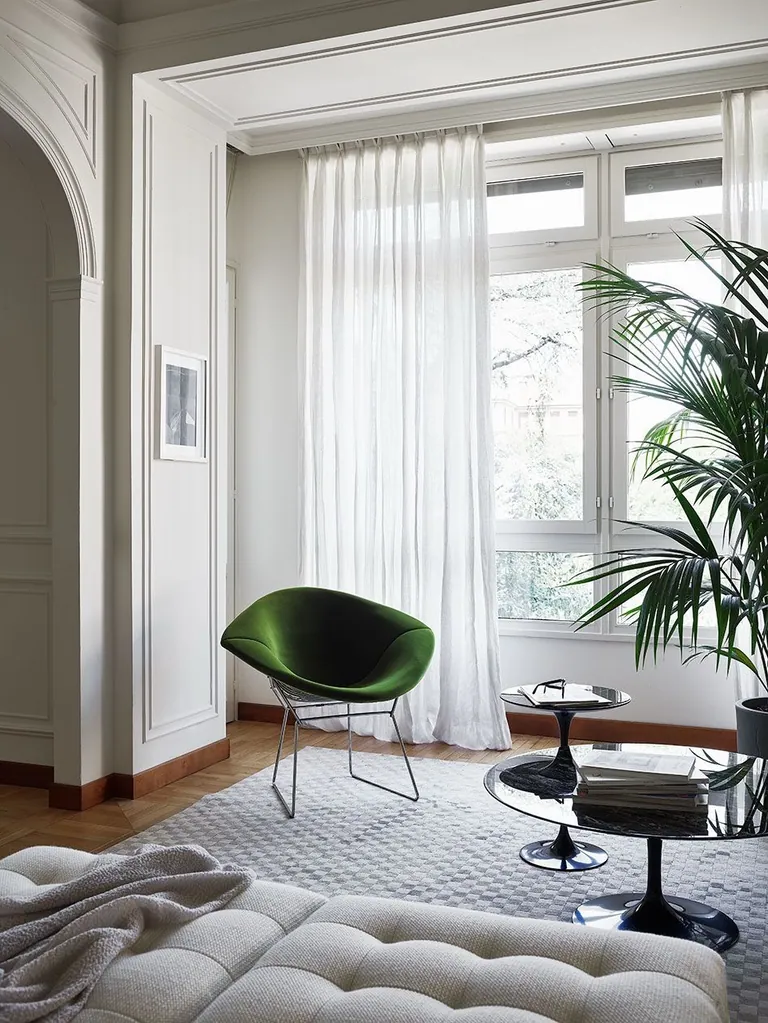
These are chairs made of a grid of steel wire ‘supported on steel cradles’, as the release puts it. Soon they include a side chair, a high-back chair known today as the Bird Chair, and above all a wide armchair whose basket is shaped like a diamond: the Diamond.
Harry Bertoia on his chairs‘They are mainly made of air, like sculpture. Space passes right through them.’
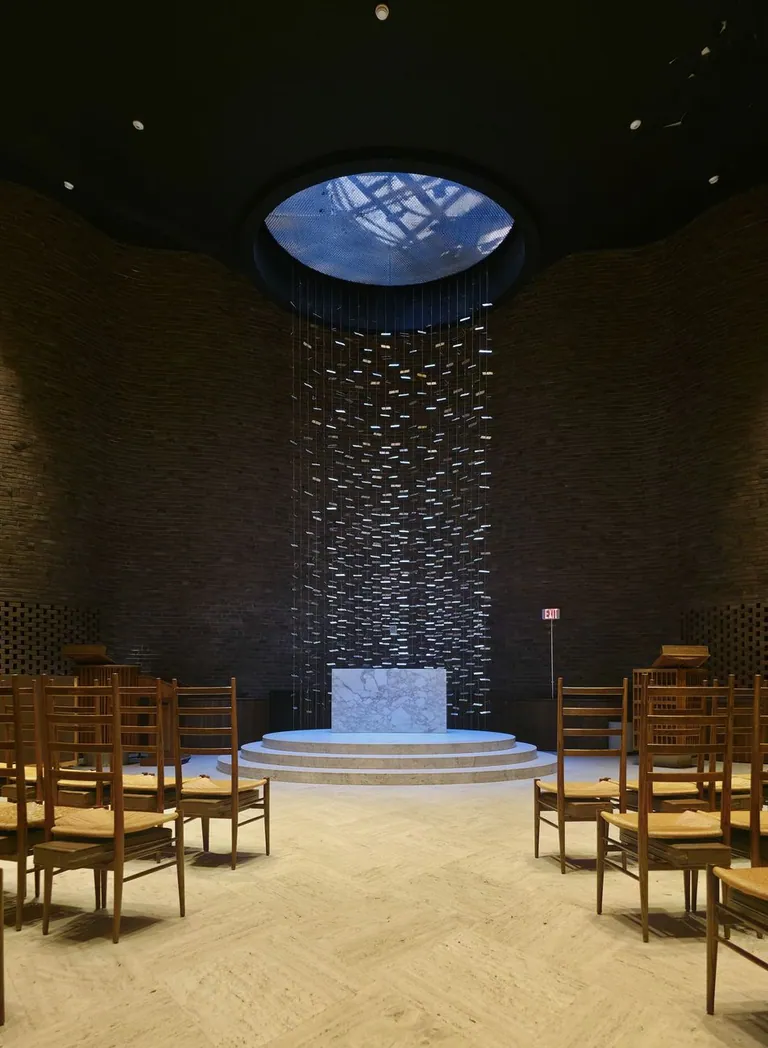
Florence Knoll had encouraged him to show a few sculptures at the opening as well, and that turns out to matter. Among the guests is Eero Saarinen, his old friend from Cranbrook, who takes note of Bertoia’s metal screens, and before long Bertoia is building a large metal screen for him at General Motors and an altar of wire and light for Saarinen’s chapel at MIT.
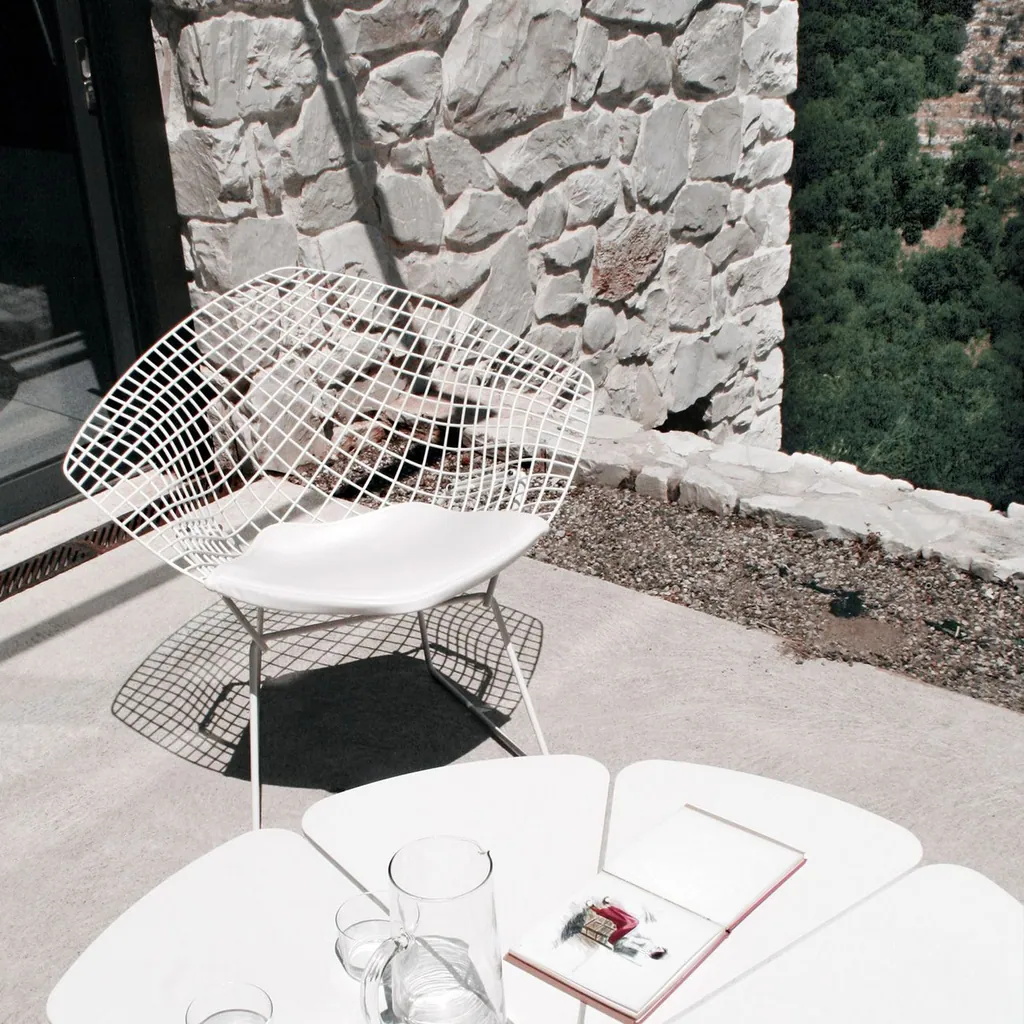
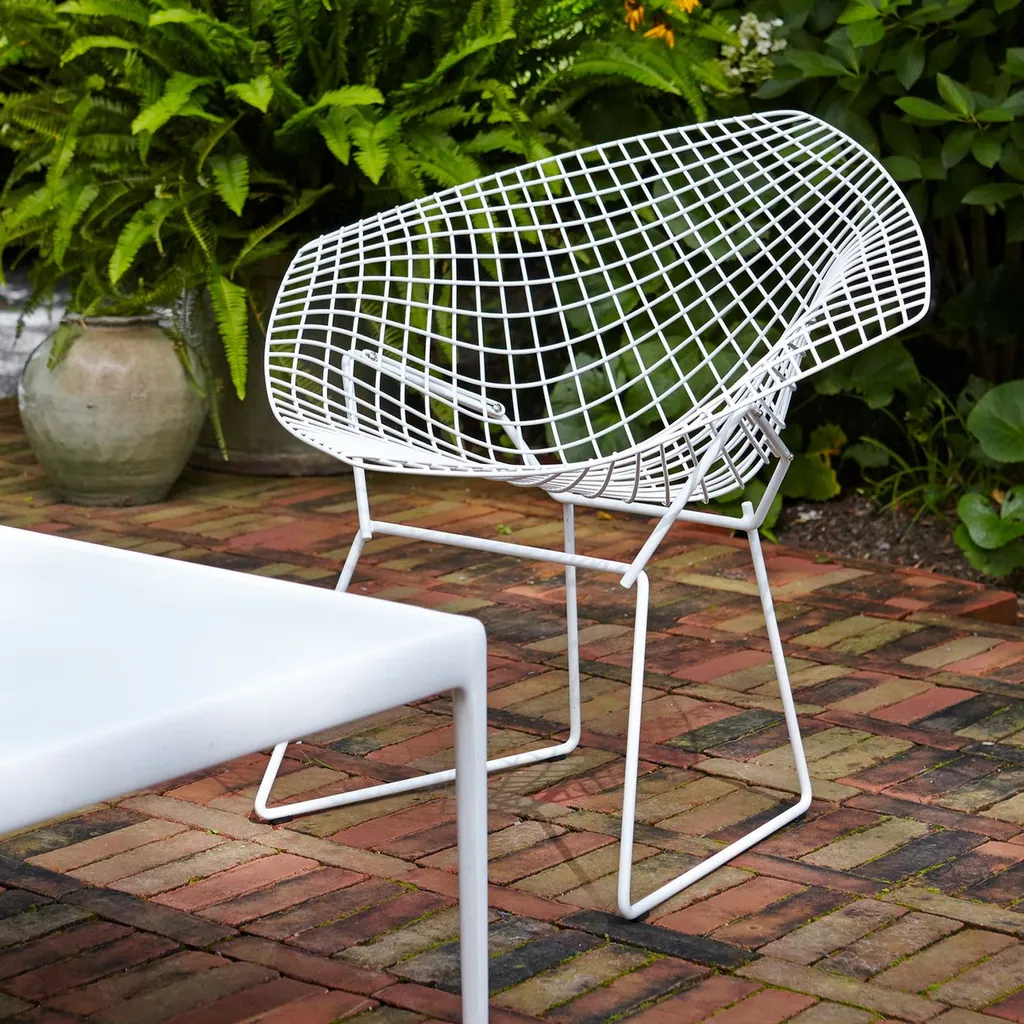
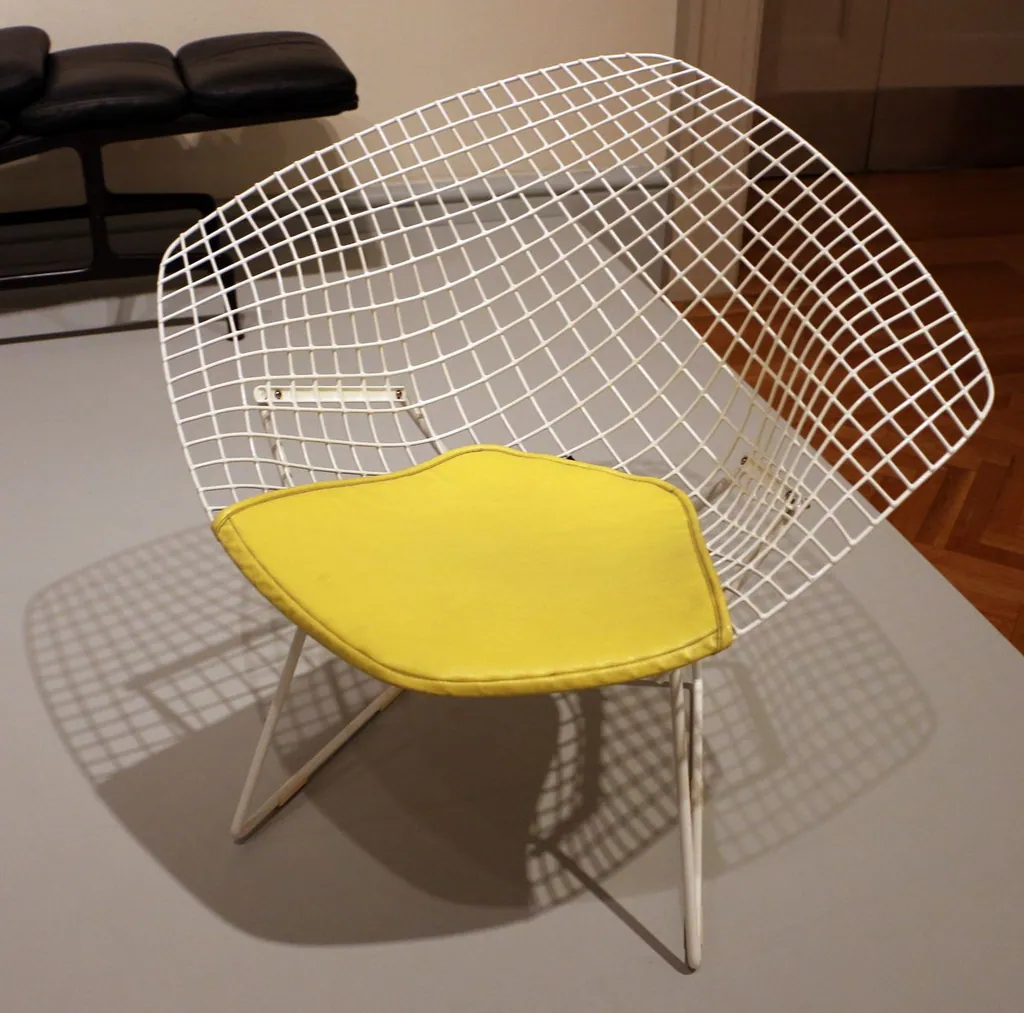
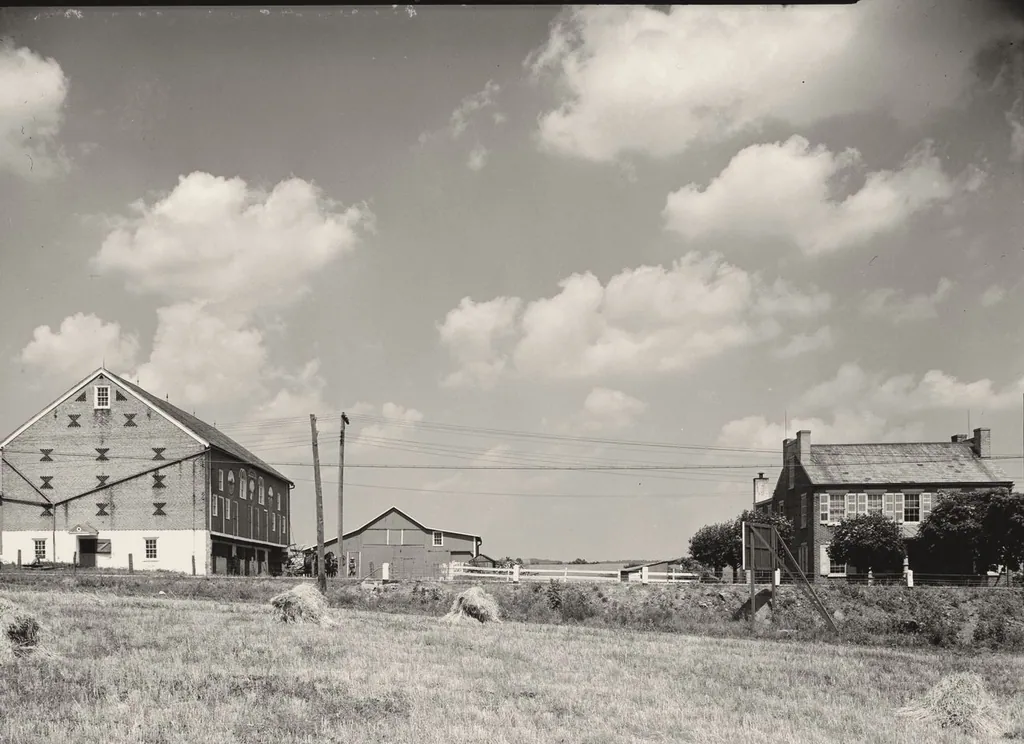
For Bertoia himself, the furniture chapter is already over. By the end of 1952 the designs are finished and the first jigs built, and he wants to get back to sculpture. As he leaves, Knoll pays him a sum for the rights to the chairs, forever, and with it he makes the down payment on the old farmhouse in the village of Barto that he has been renting. He never designs a second furniture collection.
Barto, Pennsylvania · 1960–1978
The barn that sings
Next to the house stands a barn, and around 1960 something entirely new begins there. As Bertoia bends a piece of wire, he hears it ring, and at once he wonders: if one wire sounds like that, what would two sound like? Or ten, or a hundred?
So he sets rods of brass and bronze in rows on a base plate, and they sway and ring against each other the moment you touch them. When he hears a new sculpture for the first time after welding, it is, in his words, ‘almost hearing the cry of a newborn baby’.


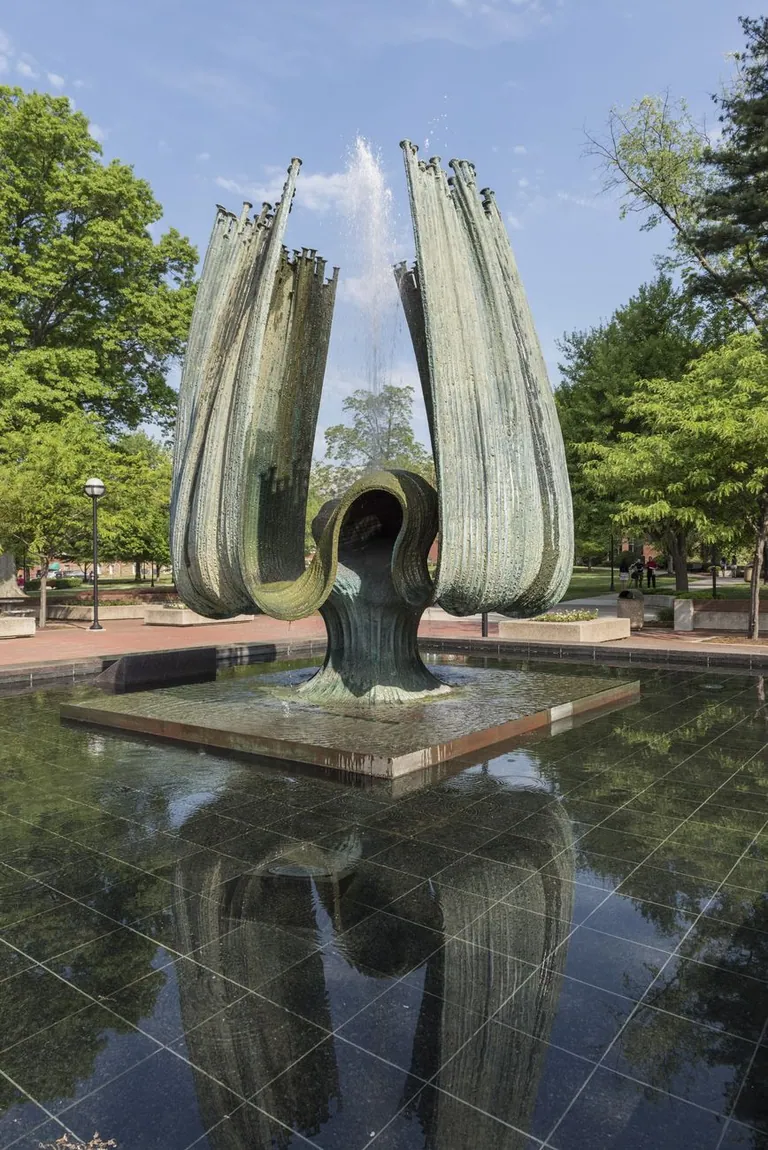
In the late sixties he turns the barn into a home for more than a hundred sound sculptures and a recording studio. Friends drop by for small concerts, and with his brother Oreste, who loves music just as much as he does, he records the sounds and calls them Sonambient. Alongside all this come more than fifty sculptures for banks, airports and universities across the country.
Harry Bertoia dies at home in 1978, aged 63, and he is buried behind his barn, beneath a large bronze gong.

He had long since left his chairs behind. They never left him. Knoll has made them without pause since 1952, in Italy since 1986 and with slightly heavier wire, and anyone who sits in a Diamond today sits in a grid that a sculptor first imagined around a body and then drew in the air with wire.

What you should know before you buy
DIAMOND AND BIRD FROM US


- 85 × 75 × 75 cm, Diamond (W × D × H)
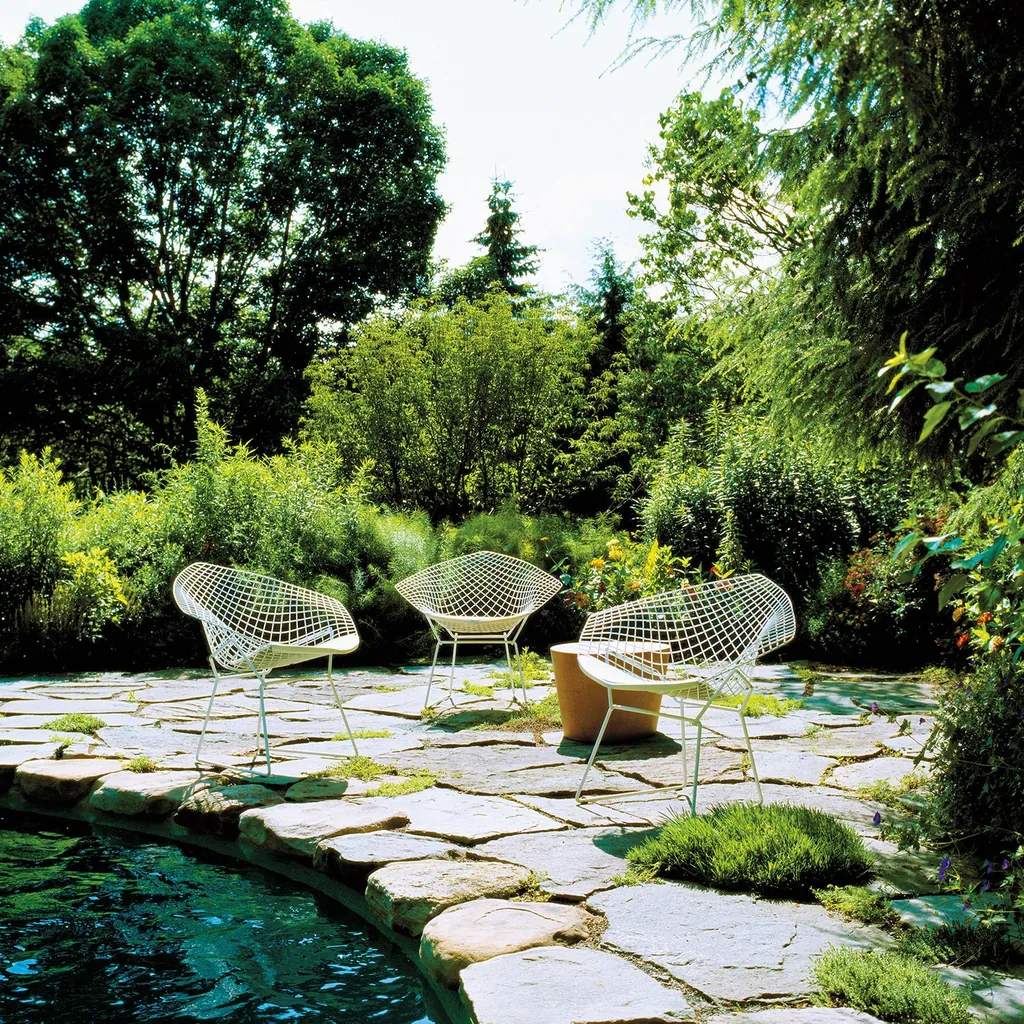
- approx. 7 kg quickly carried out to the terrace
- 98 × 89 × 101 cm, Bird Chair
Diamond without upholstery, with a seat cushion (attached with press studs) or fully upholstered. Large Diamond: 114 × 82 × 71 cm, almost 30 cm wider. Ottoman for the Bird Chair: 62 × 44 × 39 cm.
Welded steel rods, chrome-plated, gold-plated (18 carat) or coated with Rilsan, a fused-on plastic layer. Black and white in Rilsan are suitable for outdoors; chrome and gold are not.
Genuine Knoll chairs have a single heavy rim wire, not a double one (only the Bird Chair sometimes has one). The grid wires are cut at an angle, and the base overlaps the legs. On newer chairs the rim runs over the grid at the front like a small waterfall, and since 2004 ‘Knoll’ has been discreetly stamped into the frame; older chairs without the stamp can still be originals. ‘Bertoia style’, on the other hand, means a copy.
Warm water with a little washing-up liquid and a washing-up brush are all you need, and Knoll supplies replacement cushions and covers. Knoll offers a five-year warranty.
We are an authorised Knoll dealer and are happy to help with frame, upholstery and the question of Diamond or Bird. Browse the Knoll collection
Mostly air.
And still it holds you.
Sources
Brian Lutz, Knoll: A Modernist Universe (2010); Harry Bertoia Foundation, harrybertoia.org (biography, Sonambient, furniture FAQs, ‘In His Own Words’: excerpts from Paul Cummings’ interview for the Archives of American Art, 1972); Knoll, ‘Wire and Curve’, designer page Harry Bertoia and product page Bertoia Diamond Chair (knoll.com); Knoll, catalogue ‘Knoll. The Original Design’; Cooper Hewitt, Object of the Month: Small Diamond Chair (2012).
Pictures
Product photos and cut-outs: Knoll. Historical photos in the public domain: Arthur S. Siegel (FSA/OWI, 1942), Historic American Buildings Survey, Carol M. Highsmith (Library of Congress). Wikimedia Commons: Sharon Mollerus, Ajay Suresh (CC BY 2.0), Cacophony, Sailko (CC BY 3.0), NateBergin (CC BY 4.0), edited where noted; Sandstein (CC BY-SA 3.0, unedited). Unsplash: Filippo Castegnaro, Jeremy Hoye, Glenn Hansen, Manuel Cossio, Elena Zalivochkina, Hasan Mrad. Map: Natural Earth.