

A basket full of pillows
Florence Knoll wanted an armchair she could really curl up in. Eero Saarinen, something of a big brother to her since her teens, built it for her – but first a rather sceptical boat builder had to be talked round.
Hvitträsk & Cranbrook · 1910–1940
The big brother
Eero Saarinen was born in 1910 on his father’s birthday, of all days, at Hvitträsk, a studio house above a lake west of Helsinki. Eliel Saarinen, then Finland’s best-known architect, had built it himself, and as his mother Loja worked as a textile artist too, the boy grew up in a house where everything revolved around design from the very start.
When Eero was thirteen, the family emigrated to America. Near Detroit his father planned Cranbrook, a school where architecture counted for no more than painting, weaving or sculpture, and even as a teenager the son helped design furniture and lighting for the campus. Later he went to Paris to learn sculpture, and after that to Yale to study architecture.
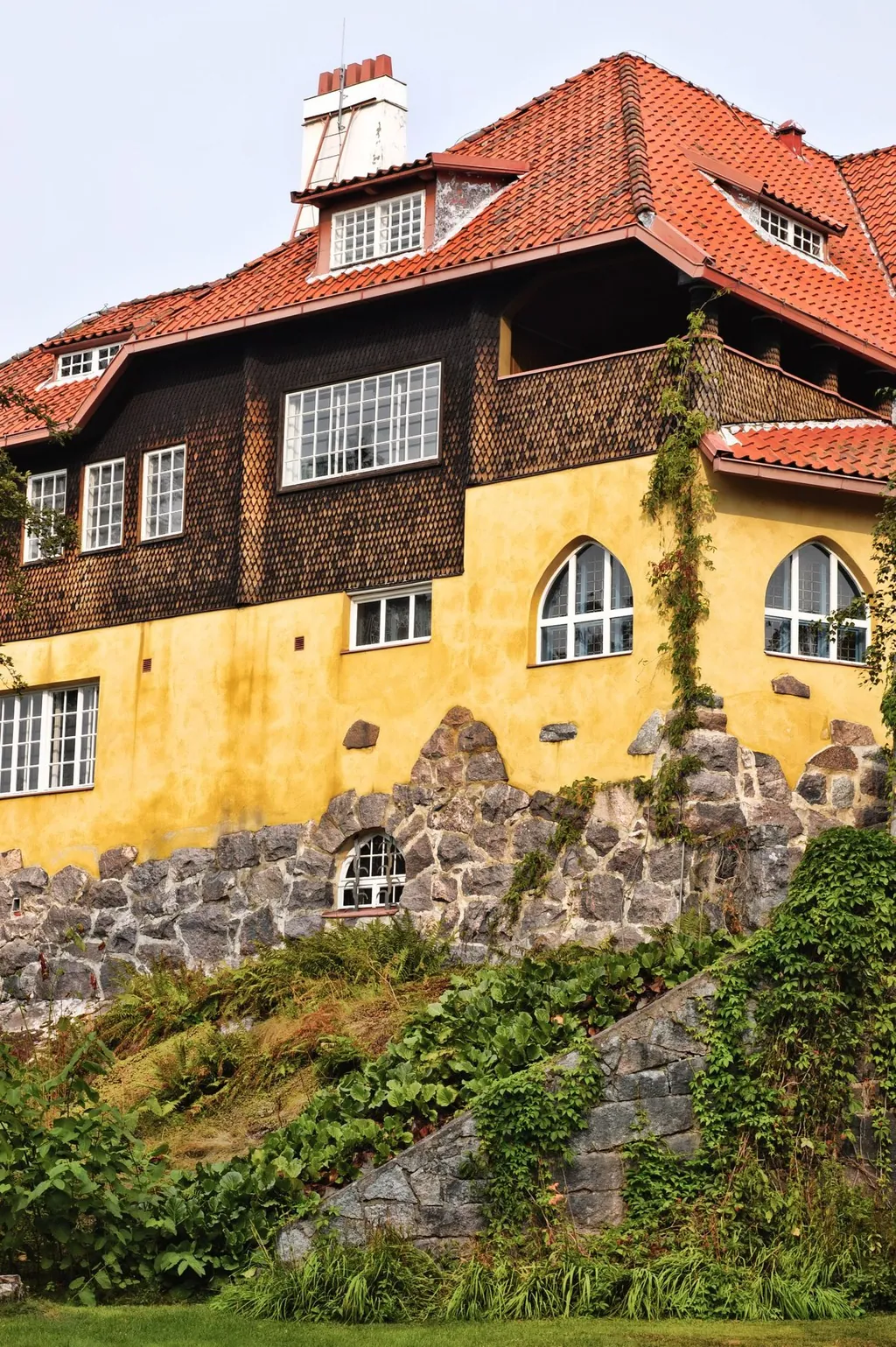
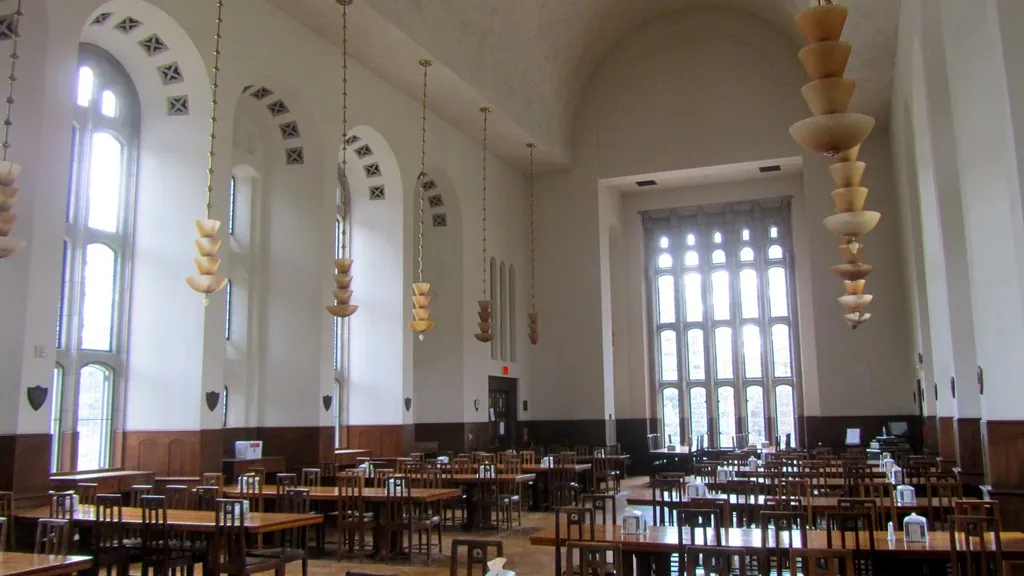
In the summer holidays of 1933 he met a girl at home whom his parents had taken in almost like a daughter. Florence Schust was sixteen, had lost her parents early, went to the girls’ school at Cranbrook and wanted to design houses one day, and she spent her summers with the Saarinens in Finland. Eero soon became something like a ‘big brother’ to her: he brought her his designs as small models, talked them through with her and took her own work apart mercilessly, ‘because he wanted me to do the best’, as she said later.
In 1940 Eero and his friend Charles Eames won a competition at the Museum of Modern Art with seat shells of moulded plywood that owed their comfort to their shape rather than to thick padding. Then came the war. Eero worked for the OSS intelligence service, while Florence went to New York, joined Hans Knoll’s small furniture company and married him in 1946.
Bloomfield Hills · 1946
A basket full of pillows
After the war Eero became Knoll’s man for the big ideas. His first armchair for the company was still strung with army-surplus parachute webbing, and after that he started out tinkering with small plastic-shell chairs.
Florence saw it differently, and this is how Knoll still tells the story today: he should take the bull by the horns and do the big one first. She wanted something ‘like a basket full of pillows’ that she could really curl up in, because the club chairs of the day were too stiff, too long and too narrow for her. She also wanted to be able to sit sideways in it, or any other way she pleased.
Eero went about it the way he went about everything: with models. For his furniture he built hundreds of them, small ones and full-size ones, until a curve was finally right, and in 1947 he even sat in one of the prototypes himself for a photograph.
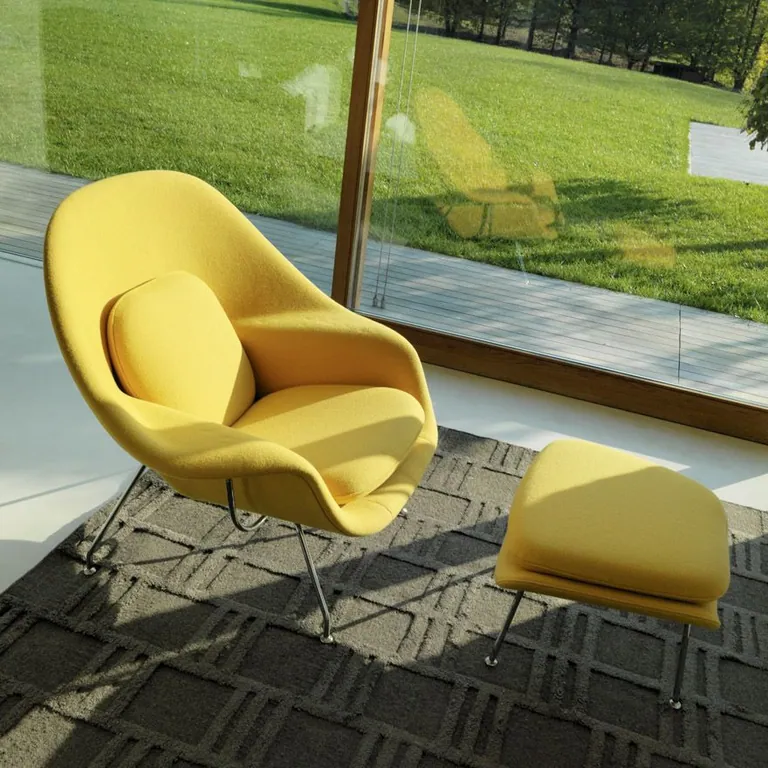
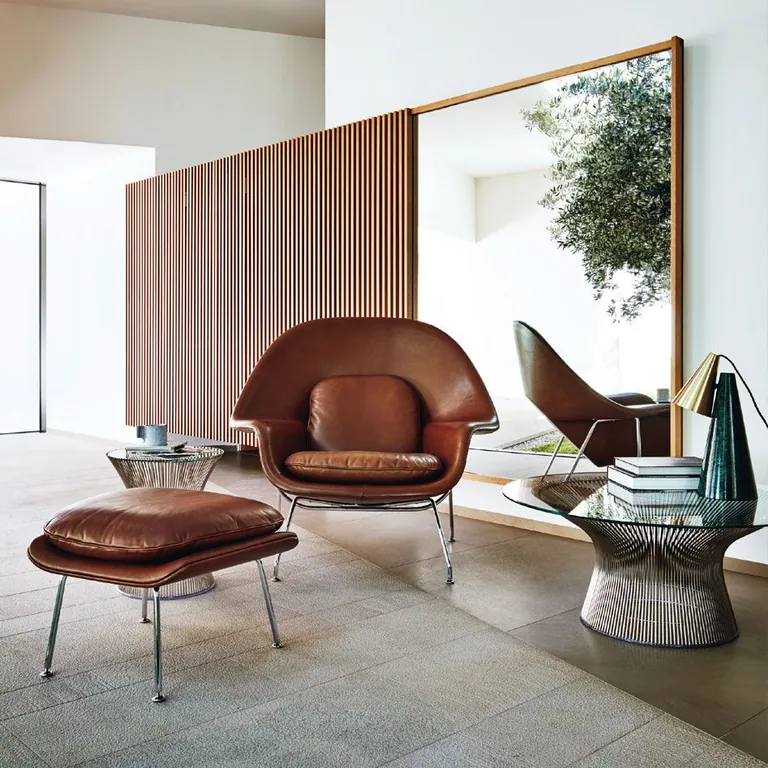
What came out in the end was of course not a basket but a wide shell that wraps around the body, with two loose cushions inside. Just as with the plywood shells of 1940, it is the shape that makes it comfortable, not thick padding. Saarinen explained the name with a wink:
Eero Saarinen on the Womb Chair‘Designed on the theory that a great number of people have never really felt comfortable and secure since they left the womb.’
New Jersey & Cape Cod · 1948
The boat builder
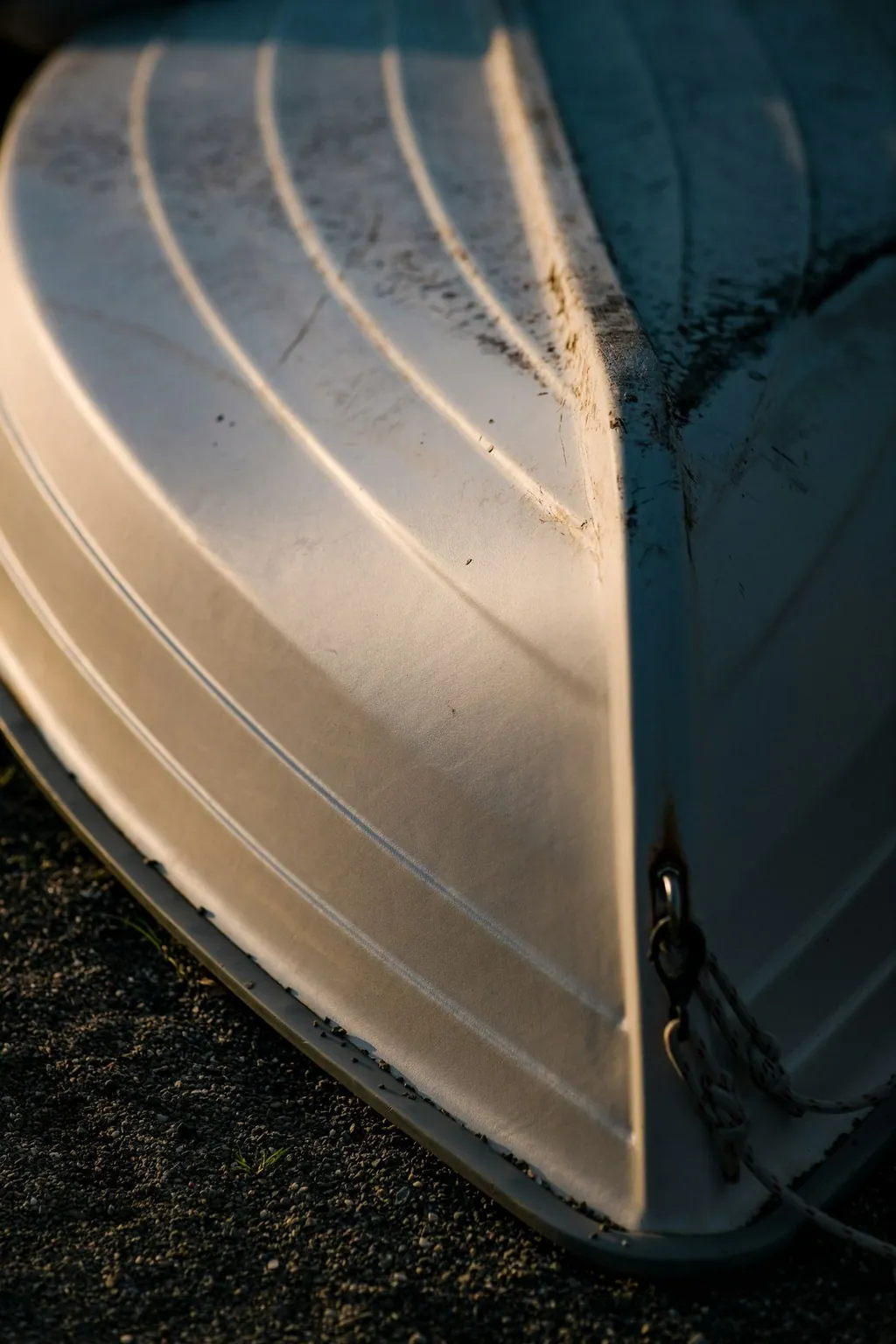
Wood will not bend into this shape, so Eero needed a new material. He found it in glass-fibre-reinforced plastic, developed during the war and now suddenly available, though nobody was making furniture from it yet. Florence and Eero tracked down a boat builder in New Jersey who was experimenting with it, but he was not keen on their idea. ‘He was very skeptical,’ Florence remembered. ‘We just begged him. I guess we were so young and so enthusiastic he finally gave in …’ It took many failures before a shell finally held, and from it came the first plastic chairs ever to be mass-produced.
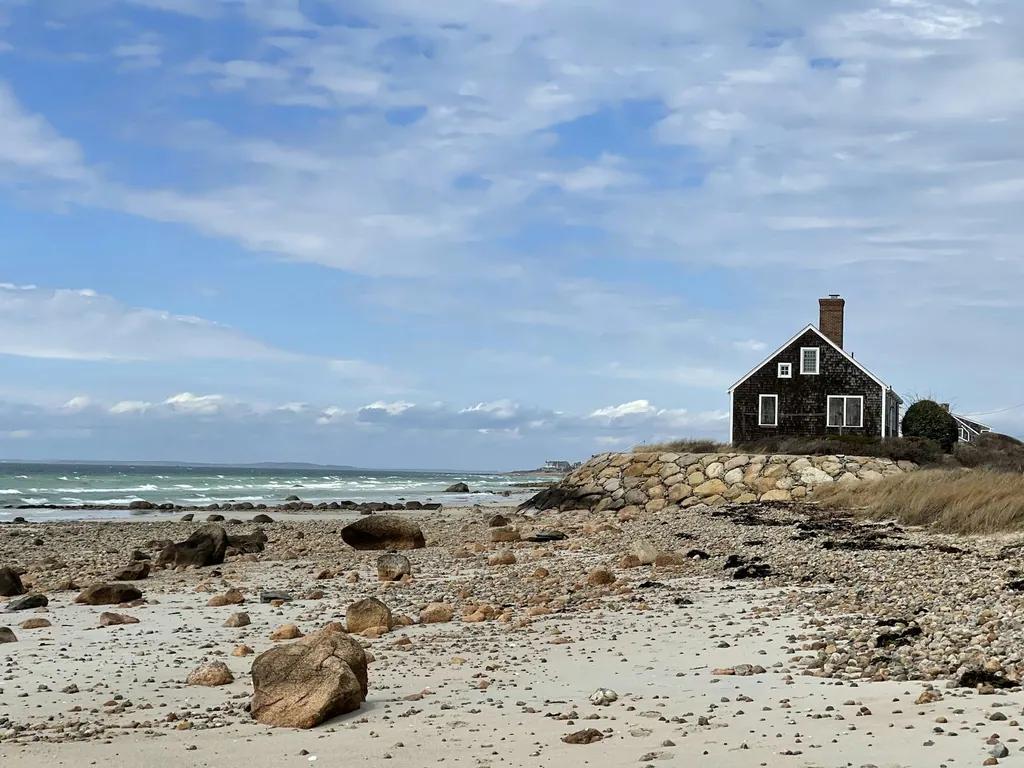
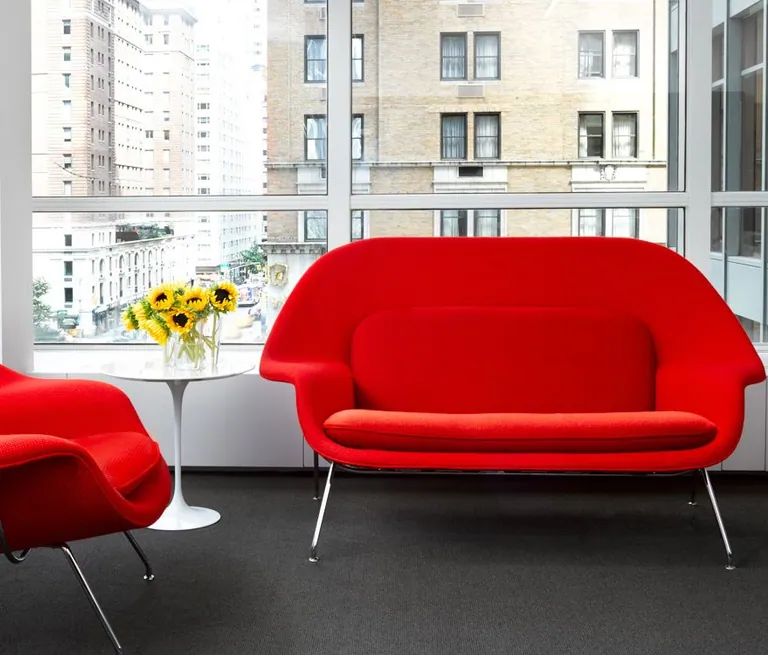
In 1948 the chair went on sale. In Knoll’s new showroom on Madison Avenue it stood in a living-room set with real flowers, and that summer the Saarinens and the Knolls celebrated the launch together on Cape Cod. A photo from the family archive shows them all together: Eliel and Loja, Eero with his wife Lily, Florence and Hans, and Eero’s little son Eric on a hobby horse.
Saarinen himself wrote that the hulking upholstered furniture of old had disappeared from modern interiors because it was made for an era that tried to impress by sheer mass. ‘Now, more than ever, we need to relax.’
A photograph did the rest. Around 1951 Knoll’s graphic designer Herbert Matter sat a soot-black chimney sweep with top hat and brush in a spotless red Womb Chair, and Florence ran the ad in Fortune and The New Yorker so that it would reach the boardrooms too. The image kept running for decades.
Detroit · 1948–1950
Fifteen models overnight
In the year the Womb Chair came out, Eero also won the competition for a memorial in St. Louis, a giant arch on the Mississippi, and the family tells a lovely story about it. After the first round a telegram arrived for ‘E. Saarinen’, and since his father had entered too, they celebrated Eliel for three days. It was Eero they meant, though.
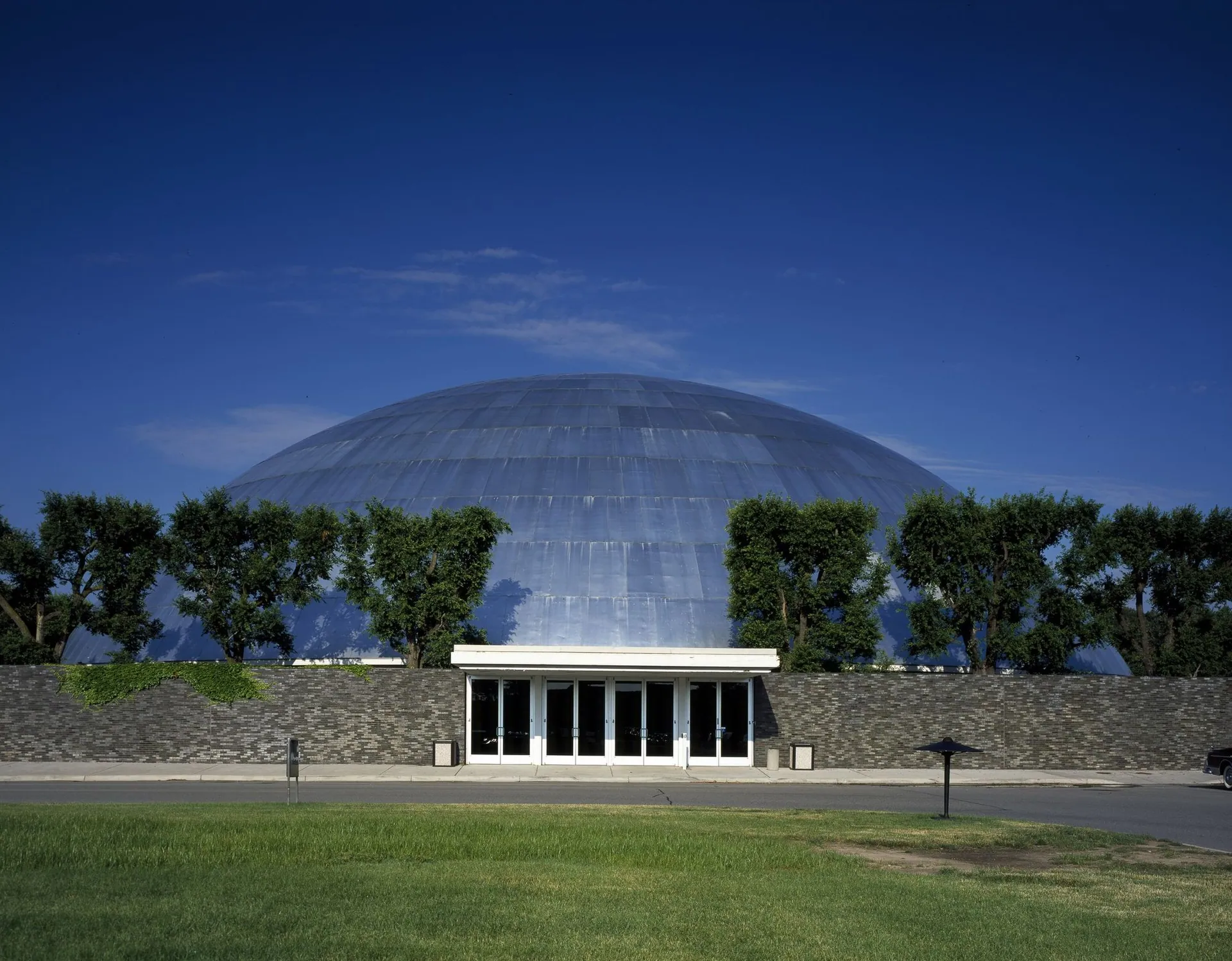
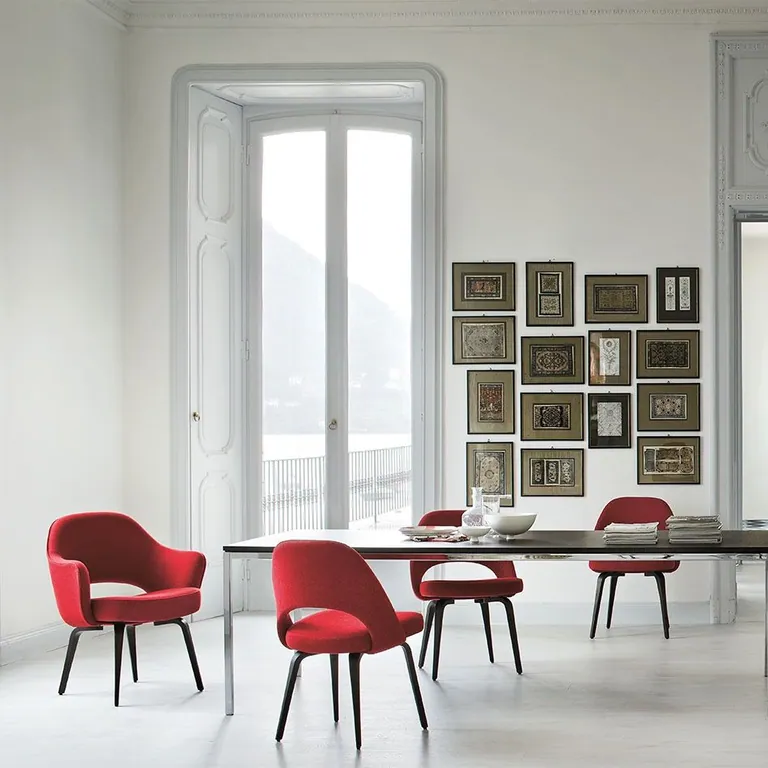
At the same time his office was planning a research campus near Detroit for General Motors, where nearly 5,000 people would work, and they all needed chairs. Eero designed them on the principle of the Womb Chair, with a moulded shell that runs right into the armrests. His young assistant Niels Diffrient remembered mornings when around fifteen small chair models made of paper and cardboard sticks were already lying in the office, cut out by Eero himself the evening before. ‘He never stopped.’
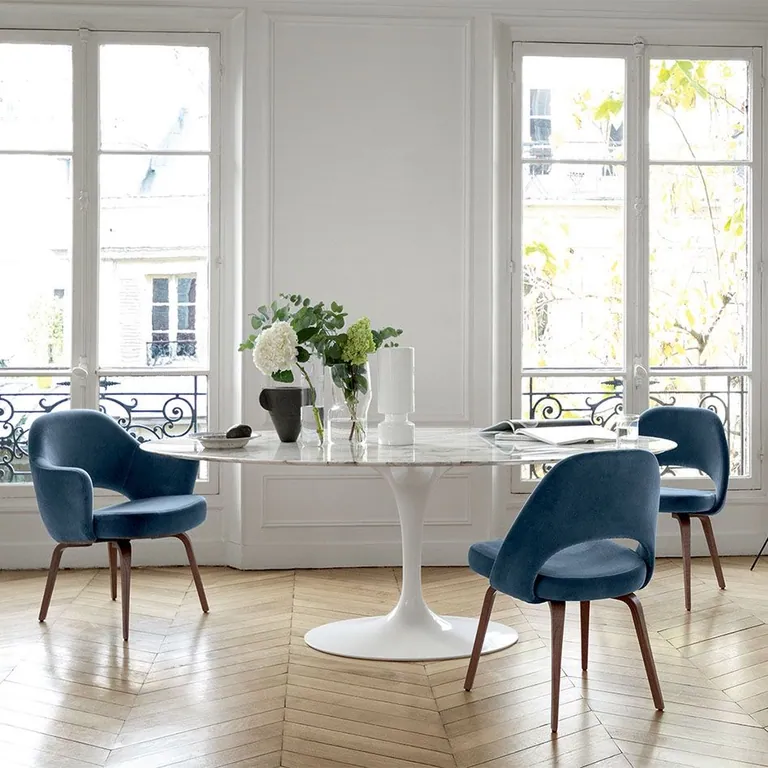
For the armchair he took one of Florence’s designs as his model, with her blessing. When it came out in 1950, Knoll built thousands of chairs for General Motors and became America’s leading maker of office furniture almost overnight. It soon became known as ‘that chair with the hole in the back’, and Florence put it in almost every room she furnished. It lasted, too: when a Knoll historian visited the site nearly sixty years later, he still found chairs there in their original upholstery, worn but still serviceable.


Bloomfield Hills · 1950–1965
Eero’s All-Night Drive-in
In the fifties Eero was one of the most sought-after architects in America, and in photos he usually looks very serious. His staff tell quite a different story, though: he loved a party, and at every party he talked about architecture. Because his office in Bloomfield Hills had no air conditioning, on hot days there was a tub of ice and lemonade, into which someone would now and then tip a few bottles of gin.
The big models were raised so high that you could put your head inside them, and for the TWA terminal at New York’s airport Eero and his closest associate Kevin Roche even crawled around on a model made of cardboard and tape. On his travels he carried a stopwatch to time how long everything took. No wonder the office was known as ‘Eero’s all-night drive-in’: it never closed.
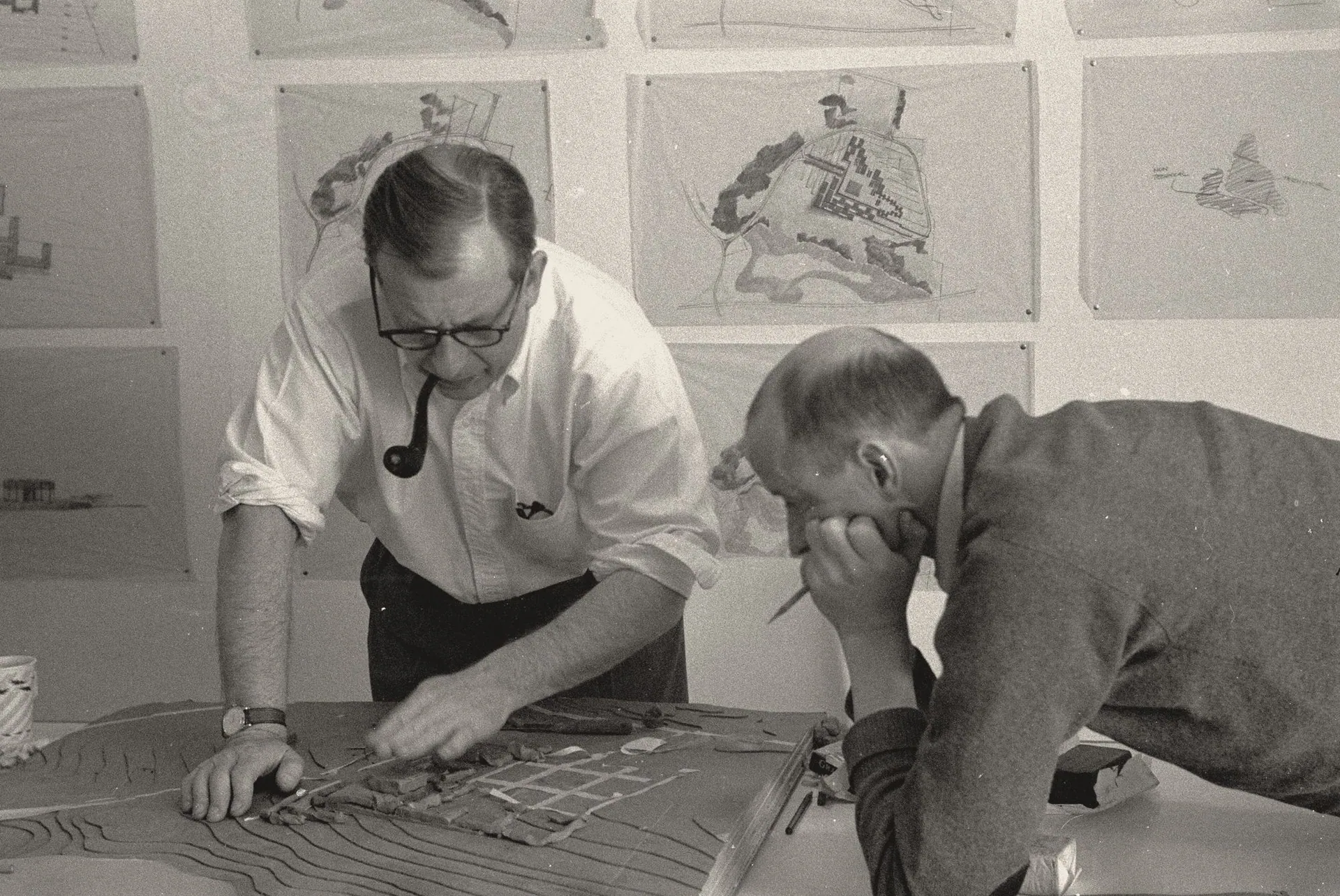
Asked what it took to make exceptional architecture, he answered without hesitation: ‘Just to do more. You can never do too much.’
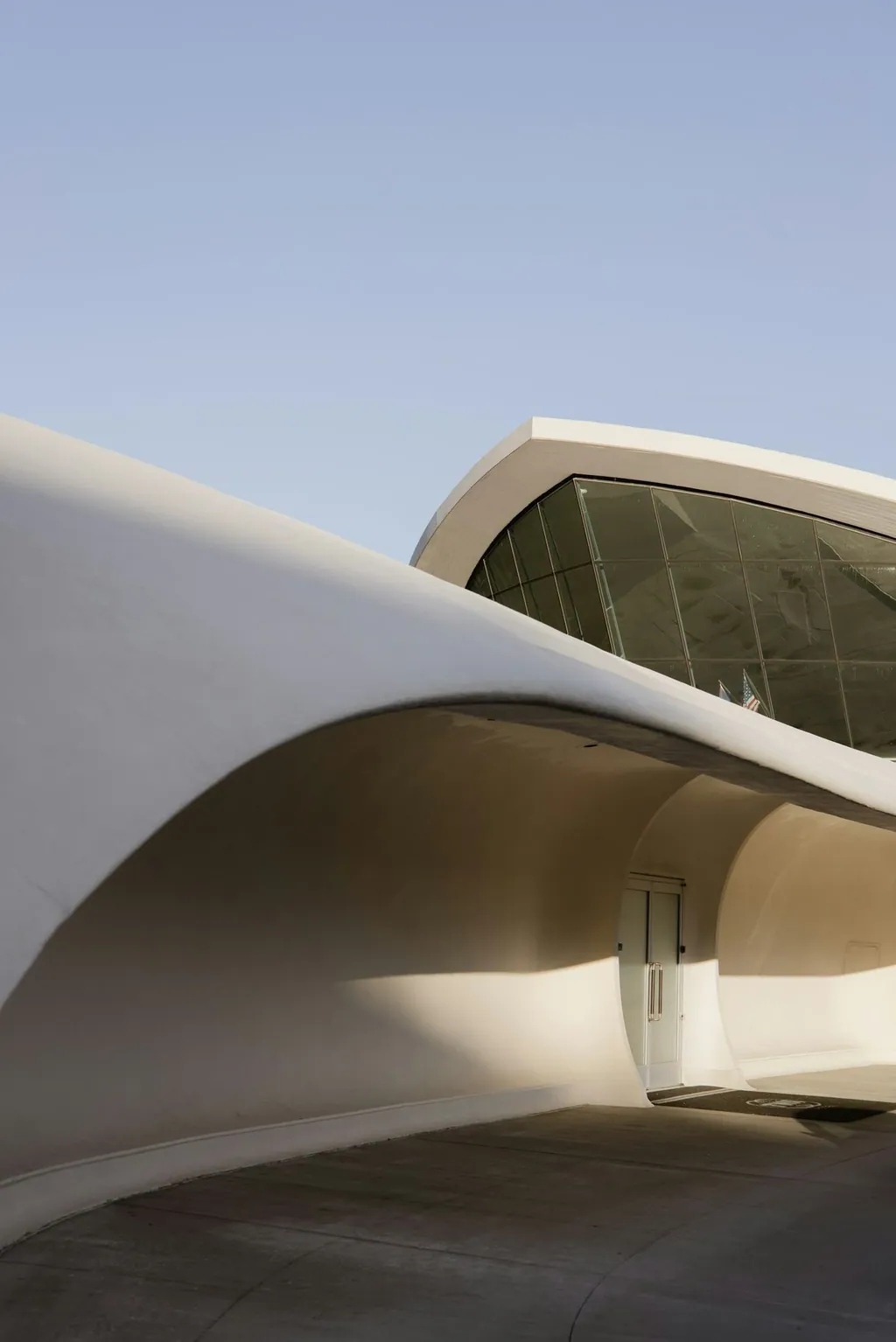
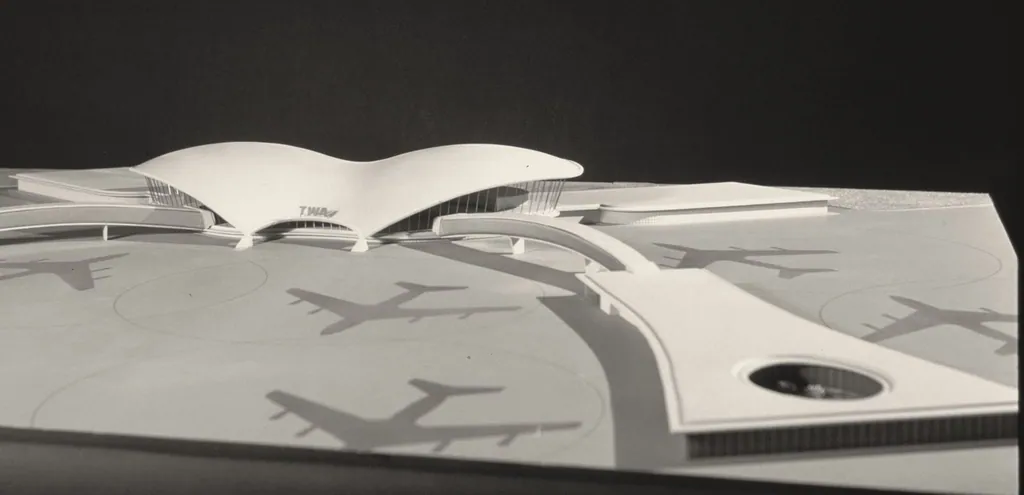

In 1958 his Tulip chairs on a single base joined the Knoll range as well. Three years later Eero Saarinen died after an operation on a brain tumour, aged just 51. When the TWA terminal opened a year later and the arch in St. Louis was completed in 1965, he was no longer there to see it.
The Womb Chair, on the other hand, has stayed in the range without a break since 1948. Only the sofa for two, designed the same year, disappeared after just three years and did not come back until decades later.

What you should know before you buy
WOMB FROM US


- 105 × 94 × 92 cm, Womb Chair Relax (W × D × H)
- 43.5 cm seat height, Relax and sofa
- 159 cm wide, the Womb Sofa
Relax is the full size, with a flexible polyurethane shell over a metal structure with elastic straps. Medium is smaller and lower (89 × 79 × 79 cm, seat height 38 cm) and sits on the moulded glass-fibre-reinforced plastic shell, like the 1948 original; fabric cover and chrome frame only.
Frame of round steel rod, high-gloss chrome-plated or black lacquered, with movable glides of stainless steel and nylon. Covers in fabric or leather; the seat and back cushions lie loose in the shell. Womb Stool (Relax): 64 × 51.5 × 40 cm.
The Knoll logo is stamped into the frame of the armchair, stool and sofa.
Work on stains in fabric from the outside in, don’t make the cloth too wet and test any cleaning product on a hidden spot first. For smooth leather a damp cloth is enough. Clean chrome with a non-abrasive glass cleaner, lacquered metal with mild soapy water.
The little sibling from 1950: shell of compression-moulded reinforced polyurethane, moulded plywood seat, with or without armrests, on four legs (chrome, black or oak) or on a swivel base with glides or castors. Armchair on four legs: 65.5 × 63 × 81.5 cm, seat height 46 cm.
We are an authorised Knoll dealer and are happy to help you with size, cover and frame. Browse the Knoll collection
Sit however you like.
That is exactly what it was built for.
Sources
Brian Lutz, Knoll: A Modernist Universe (2010); Brian Lutz, Furniture, form and innovation, in: Eero Saarinen. Shaping the Future (2006), quoted by the Victoria and Albert Museum; Paul Makovsky, Iconic Workplace: Eero Saarinen and Associates, Metropolis (2008); PBS American Masters, Eero Saarinen (2016); National Park Service, Gateway Arch National Park; Knoll and Knoll International, designer and product pages, product data sheets and care instructions.
Pictures
Historical photos in the public domain: Balthazar Korab (Library of Congress), National Park Service (1965), Carol M. Highsmith (Library of Congress). Product photos: Knoll. Hvitträsk: stanhua (CC BY 2.0). Cranbrook: EllenM1 (CC BY 2.0). Unsplash: Jason Leung, Lisa Forkner, Josh Withers, Fleur, Jacob Granneman. Pexels: Alisa Skripina.